8/7/2025
Reviews
Smart Ways to Get More Reviews [Guide]
Practical, proven ways for any business to get more authentic reviews.

TLDR: When a customer threatens a bad review to force a refund, do not answer under pressure. Separate the service problem from the threat: decide the refund on its own merits, then respond in writing with a calm, documented reply. Caving trains your worst customers to aim at your rating, and a review posted purely to extort you can often be reported and removed. This guide gives you the decision framework, the exact scripts, and a way to catch these before they ever reach Google.
The text comes in around 8pm. “I want a full refund or I’m leaving a 1-star review on Google and telling everyone in the neighborhood Facebook group.” The job was finished two days ago. Your tech said it went fine. Now you’re standing in your kitchen, phone in hand, doing math on what one bad review costs versus what the refund costs, and your stomach is in a knot.
If a customer is threatening a bad review to get a refund right now, here is the short version: do not answer under pressure, and do not reward the threat. Separate the two questions hiding inside that message. First, is the service complaint fair? Second, is the threat something you’re willing to pay for? The first deserves a real answer. The second never does.
Let me walk through exactly how to handle it, the words to send, and how to keep it from happening again.
A single review will not sink you. A business with 150 reviews at 4.7 stars is more trustworthy to buyers than one with 6 reviews at a perfect 5.0, and 82% of shoppers specifically read the negative reviews to see how a company handles problems. One angry 1-star review, sitting under a well-written owner response, often does more to build trust than harm it.
What actually costs you is the pattern. The moment you pay a review threat, you have taught that customer, and anyone they talk to, that your rating has a price. The average refund on a service job might be $150 to $600. The customer who learns that threats work will come back for the next one, and the one after that. You are not buying peace. You are buying a subscription to being squeezed.
So the fear that’s driving you right now, “this review will wreck my rating,” is usually the smaller risk. The bigger risk is what you become known for if you cave.
This is the whole game. Inside that threatening message are two completely different questions, and you have to answer them separately or you’ll make a bad decision.
Question one is the service question. Did something actually go wrong? Was the work sloppy, the price higher than quoted, the appointment missed? Pull the job record and talk to whoever was on site before you decide anything. If there’s a real problem, you fix it, the same way you would for any customer who never mentioned a review at all.
Question two is the threat question. Should the refund be bigger, faster, or more generous because they threatened your rating? The answer is no. The threat gets zero weight in what you offer. If a $200 partial credit is fair, it stays $200 whether they’re polite or holding a 1-star review over your head.
When you keep these separate, the decision gets simple. You are not negotiating with the threat. You are handling a service issue on its merits and declining to pay a premium for the intimidation.
There are really only three moves when the threat lands. Here is what each one actually does for you.
| Your move | When it fits | What it costs you |
|---|---|---|
| Cave to the threat | Almost never | The refund, plus a reputation among difficult customers that your rating is for sale. Invites repeat squeezes. |
| Hold the line, offer a fair fix | The complaint has some merit but the demand is inflated | A reasonable credit or redo, decided on the facts. Protects your standing. Usually your best move. |
| Decline entirely, document it | The work was correct and the demand is pure extortion | A short-term risk of one review you can often report. No money, no precedent. |
Notice that “cave” is almost never the right call, even though it feels like the safest one at 8pm. The two defensible moves both start from the facts of the job, not from the size of the threat.
Do not have this conversation live on the phone if you can help it, and never over a stream of angry texts you fire back in the moment. Move it to writing, stay calm, and keep it short. Writing does three things for you: it slows the pace down, it keeps you from saying something you’ll regret, and it creates a clean record if the review gets posted and you need to report it.
Here are the replies I actually send.
When the complaint has some merit (offer a fair fix, ignore the threat):
Hi [Name], thanks for letting me know you’re not happy with the [job]. I want to make this right. Based on what you’ve described, I’d like to [send a tech back to correct X / credit you $Y for the part that fell short]. I’ll take care of that regardless of anything posted online. Can we get [the fix] scheduled for [day]?
Notice what that does. It owns the real issue, offers a concrete resolution, and quietly signals that the review is not part of the negotiation (“regardless of anything posted online”). You’re being generous about the service and firm about the threat, at the same time.
When the work was correct and the demand is pure leverage:
Hi [Name], I’ve reviewed the job details and the work was completed as agreed on [date] for the amount quoted. I’m always glad to address a specific problem with the work, so if something isn’t functioning, tell me what it is and I’ll look into it. I’m not able to issue a refund in exchange for a review, and I’d ask that any review you leave reflect your actual experience. I’m happy to help with a genuine issue.
That reply is polite, it leaves the door open for a real complaint, and it puts on the record that they asked you to pay for a review. That last part matters, because it’s often the thing that gets the review removed later.
In plain terms: leaving an honest negative review is protected, but demanding money in exchange for not posting one crosses into territory the platforms explicitly forbid, and in clear cases can meet the legal definition of extortion. You are not a lawyer and neither am I, so keep your response about the service. But you should know your footing.
Google’s and Yelp’s policies both prohibit reviews that involve a conflict of interest or are used as leverage to extract something from a business. When a customer’s own texts say “refund me or I leave a 1-star review,” that is close to a textbook policy violation. If they follow through and post, you report the review and submit the message thread as evidence. This is exactly why you keep everything in writing. For the full mechanics of getting a bad-faith review taken down, see how to remove a fake Google review.
One important line for your own protection: never offer to pay for a review to be removed or changed, and never offer discounts in exchange for positive reviews. That’s review gating, and it can get your account penalized. Handle the service issue; let the platform handle the bad-faith review.
Sometimes you get to the phone too late and the review is already live. Do not panic, and do not respond in the first 30 minutes while you’re hot. Then:
Here’s the uncomfortable truth about most review threats. By the time a customer is typing “refund or 1 star,” they’ve usually been frustrated for a while and felt they had no other way to get your attention. The threat is a last resort, not a first instinct. Most people who are genuinely happy, or even mildly annoyed but heard, never reach for it.
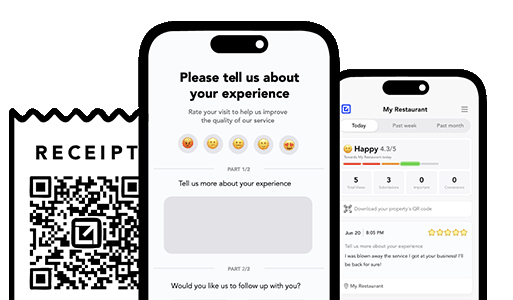
That’s the gap a simple post-job follow-up closes. When every customer gets a private check-in a day or two after the job that asks “how did everything go,” the unhappy ones reply to you instead of stewing until they reach for the nuclear option. You catch the problem while it’s still a normal service issue you can fix for the price of a return visit, long before it hardens into an ultimatum. This is the same idea behind intercepting negative reviews before they happen, and it’s the core of a fast 15-minute recovery process.
This is exactly what VisibleFeedback was built to do. It sends an automatic follow-up after every job, catches unhappy customers privately, and alerts you instantly so you can resolve a problem before it ever turns into a public threat. Happy customers get pointed toward Google; frustrated ones get routed straight to you. It’s the difference between finding out about a problem in your inbox versus finding out in a 1-star review.

Should I ever refund a customer who threatened a review? Yes, if the refund is warranted by the service problem on its own. Decide the amount as if the threat were never made. What you should never do is inflate the refund, or issue one for work that was done correctly, purely to make the threat go away.
Can I get a review removed if they threatened me first? Often, yes. Reviews used as leverage to extract money violate Google’s and Yelp’s policies. Report the review and include screenshots of the messages where they demanded a refund in exchange for not posting. This is why you keep the whole exchange in writing.
What if they say they’ll post on Facebook groups and Nextdoor too? Same principle. Respond once, calmly and in writing, address any real issue, and decline to pay for silence. Neighborhood groups are moderated by people who have seen this play a hundred times, and a calm, professional operator usually reads better than an angry customer making demands.
Is it worth just paying $200 to avoid the hassle? Rarely. The $200 is the small cost. The real cost is teaching that customer, and everyone they talk to, that your rating has a price. You’ll pay it again.
How do I stop this from happening in the first place? Follow up with every customer privately after the job so problems reach you before they reach a review site. Most threats come from people who felt they had no other way to be heard.
A customer threatening a bad review for a refund is trying to get you to make a fast, emotional decision. Don’t. Slow it down, put it in writing, and split it into two questions: is the service complaint fair, and should the threat change what I offer? Handle the first honestly. Answer the second with a firm no, every time.
Do that consistently and two things happen. Your worst customers stop seeing you as an easy target, and your best customers, the quiet majority who would never dream of threatening you, keep your rating exactly where it belongs.
Start a free 14-day trial of VisibleFeedback, no credit card required, and catch the next problem before it ever becomes a threat.
Austin Spaeth is the founder of VisibleFeedback, a follow-up and retention tool built for service businesses. He writes about customer retention, reputation management, and repeat revenue for small service companies.
Email clients after every job. Catch issues early, recover unhappy clients fast, and drive repeat work with smart reminders.

Austin Spaeth is the founder of VisibleFeedback, a tool that helps service companies automate post-job follow-ups, catch issues early, and drive repeat work with smart reminders. With a background in software development and a focus on practical customer retention systems, Austin built VisibleFeedback to make it easy to email customers after every job, route problems to the right person, and keep relationships strong without awkward outreach. When he’s not building new features or writing playbooks for service businesses, he’s wrangling his six kids or sneaking in a beach day.
Whether you’re dealing with callbacks, unhappy customers, or low repeat work, we’ll help you tighten the follow up loop.
No credit card required.
