TLDR: To rank for “near me” searches, Google weighs three things: relevance (a complete, accurate Google Business Profile), distance (where you actually are relative to the searcher), and prominence (your review count, rating, recency, and overall activity). You cannot move your address, so the game is won on relevance and prominence. The single biggest lever most local businesses ignore is a steady flow of fresh reviews, which signals to Google that you are active and trusted right now.
How do “near me” searches actually work?
When someone types “plumber near me” or “HVAC near me” into their phone, Google does not show them a random list. It shows a ranked set, and almost everyone taps one of the top three results in the map box, called the local pack or three-pack. If you want more calls from your area, the real goal is simple to state and hard to ignore: rank in the top three for the “near me” searches your customers actually make.
Here is the part that surprises most owners. To rank for “near me” searches, the searcher usually does not even type “near me” anymore. Google treats almost every local-intent search as a “near me” search automatically, using the phone’s location. So “emergency electrician,” “best lawn care,” and “24 hour locksmith” all get filtered through your proximity and your profile strength. The words “near me” are really just shorthand for how Google already thinks about local results.
The good news: the way Google chooses those top three is public, consistent, and mostly within your control. Let me break down the three factors, then give you the exact steps to climb.
Factor 1: Relevance (does your profile match the search?)
Relevance is how well your business matches what someone is looking for. Google figures this out mostly from your Google Business Profile, the free listing that powers your map result. The more complete and accurate it is, the better Google understands who you are and when to show you.
This is the easiest factor to fix, and it is the one most owners leave half-finished. Things that move relevance:
Primary category. Pick the most specific one that fits. “Plumber” beats “Contractor.” If you mainly do drain work and that category exists, use it. Your primary category carries a lot of weight for “near me” matches.
Services and attributes. List every service you offer, with short descriptions. If you do water heater installs, say so explicitly, because that is a search someone makes.
Business name, address, phone, hours. Keep them accurate and identical everywhere online. Inconsistent info confuses Google and costs you rank.
Photos. Real photos of your team, trucks, and completed work. Profiles with genuine photos get more clicks, and engagement feeds back into ranking.
Distance is exactly what it sounds like: how far your business is from the person searching. If someone in the north end of town searches “pest control near me,” a company based downtown has a built-in disadvantage against one two miles closer.
You cannot cheat this one, and you should not try. Fake addresses and virtual offices violate Google’s guidelines and can get your profile suspended, which wipes out everything else you have built. What you can do is make distance work in your favor honestly:
Set an accurate service area if you travel to customers, so Google knows the full region you cover.
Earn reviews that mention neighborhoods and nearby towns you serve. When a review says “came out to Maplewood fast,” that reinforces that you are relevant to searches in Maplewood.
If you have multiple locations, give each one its own complete, separately managed profile.
Distance sets the field of who is even eligible to show. Relevance and prominence decide who wins among them. Which brings us to the factor you have the most control over.
Factor 3: Prominence (how trusted and active do you look?)
Prominence is Google’s read on how well-known and well-regarded your business is. It pulls from links, mentions, and your overall web presence, but for local service businesses the loudest signal by far is your reviews: how many you have, your star average, and critically, how recent they are.
This is where the real fight for “near me” rankings is won or lost, and it is where most businesses quietly lose. Three review signals matter:
Volume. More reviews signal more trust. A profile with 150 reviews reads as more established than one with 25, and it is far more resilient when a bad review lands. This is covered in depth in why low review volume is costing you traffic.
Rating. Your star average is a visible trust cue and a ranking input. A 4.8 beats a 4.2, and it beats a suspicious 5.0 with only six reviews.
Recency. This is the one almost everyone misses. A steady drip of new reviews tells Google you are active and relevant right now. A profile whose last review is from eight months ago looks stale, no matter how good the old reviews were. Recency is a ranking factor in its own right, as explained in do old reviews still count.
Here is the pattern I see constantly: a genuinely better business gets out-ranked by a mediocre competitor simply because the competitor asks every customer for a review and the better business asks nobody. Consistency beats quality in the rankings, which is maddening until you fix it.
The relevance, distance, prominence scorecard
Run your own business through this quick scorecard to see where your gap is. Be honest, and compare yourself to whoever is actually ranking above you for your main “near me” search.
Factor
What Google looks at
You are strong if
You are weak if
Relevance
Primary category, services, complete profile
Every field filled, specific category, real photos
Half-empty profile, vague category, no photos
Distance
Your location, service area accuracy
Accurate address and service area set
Wrong service area, or chasing areas you are far from
Prominence (volume)
Total number of reviews
More reviews than the businesses above you
A fraction of your competitors’ counts
Prominence (rating)
Your star average
4.6 or higher with real volume
Below 4.3, or a thin perfect 5.0
Prominence (recency)
Date of your newest reviews
New reviews every week or two
Months since your last review
Most businesses pass relevance and distance and fail hard on prominence, specifically on volume and recency. That is the gap to close.
How to actually climb into the “near me” top three
Here is the checklist I hand owners who want to rank for “near me” searches. None of it requires an SEO agency or a big budget. It requires consistency.
Claim and fully complete your Google Business Profile. Every field, right category, accurate hours, real photos.
Match your name, address, and phone everywhere online so Google trusts your info.
Set an honest, accurate service area if you travel to customers.
Ask every single customer for a review right after the job, while the experience is fresh.
Keep the asks steady, a few a week, so new reviews keep landing and your profile looks active.
Respond to every review, good and bad, because engagement is a signal and it reassures future readers.
Catch unhappy customers privately first, so problems get fixed instead of becoming public one-star reviews that drag your average down.
Post updates and photos to your profile occasionally to reinforce that you are active.
The two points that do the most work are the steady review asks and catching unhappy customers before they go public. For a deeper tactical breakdown of the SEO side, local SEO tactics that actually work pairs well with this.
Where this gets hard, and where automation helps
Everything above is simple on paper. In practice, the review habit is where it falls apart. You finish a job, you are already driving to the next one, and asking for a review is the last thing on your mind. Do that for a month and your flow dries up, your profile goes stale, and your “near me” rank slides while a less talented competitor who automated the ask climbs past you.
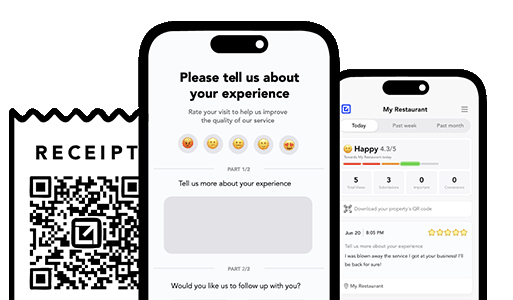
This is the exact gap automated follow-up closes. Instead of relying on your memory after a long day, a tool sends every customer a friendly check-in automatically once the job is done. Tools like VisibleFeedback do two things at once here: they route anyone who had a bad experience privately to you so you can fix it before it becomes a public one-star, and they point happy customers straight to your Google review page. That steady, filtered flow is precisely the volume, rating, and recency that prominence rewards.
VisibleFeedback was built to catch issues before they show up on Google or Yelp and to keep fresh reviews landing week after week without you having to think about it. Because it is no-contract and affordable, from $65 a month instead of the $299 to $699 the big reputation platforms charge, it fits a local service budget while doing the one thing that moves “near me” rankings most.
Automate follow ups after every job
Catch issues early and drive repeat work with smart reminders.
How long does it take to rank for “near me” searches? It depends on your starting point and your competition, but most local businesses see movement within two to three months of fixing their profile and starting a steady review flow. Relevance fixes (completing your profile) can help within weeks. Prominence (building review volume and recency) compounds over months. The businesses that win treat it as an ongoing habit, not a one-time project.
Do I need to use the phrase “near me” on my website or profile? No, and stuffing “near me” into your text does not help. Google adds the location intent automatically based on the searcher’s device. What helps is naming the actual cities, neighborhoods, and services you cover in a natural way, and earning reviews that mention them.
Why does a competitor with worse reviews rank above me for “near me”? Usually one of three reasons: they are physically closer to more searchers, their Google Business Profile is more complete and better categorized, or they have more total reviews and fresher ones than you. A 4.5 with 200 recent reviews often out-ranks a 4.9 with 20 stale ones, because volume and recency signal active trust.
Does my star rating or my review count matter more for ranking? Both matter, and they work together. A high rating with almost no reviews looks thin and unproven. A large review count with a poor rating signals real problems. The sweet spot is a strong average (roughly 4.6 or higher) backed by steady volume and recent dates. For a sense of targets, see how many Google reviews you need.
Can I rank for “near me” if my business runs from home or has no storefront? Yes. Service-area businesses can rank well by setting an accurate service area, hiding the home address if needed, and building the same relevance and prominence signals. Distance is measured from your real location, so you compete best in the areas genuinely close to you.
The bottom line
Ranking for “near me” searches is not a mystery and it is not luck. Google chooses the top three on relevance, distance, and prominence. You cannot move your building, so you win by finishing your Google Business Profile and, above all, by keeping a steady stream of fresh, genuine reviews coming in while catching problems privately before they become public ones.
That second part is the habit almost no one keeps by hand. If you would rather have the post-job check-in, the private problem-catching, and the review ask happen automatically after every single job, start a free 14-day trial of VisibleFeedback, no credit card required.
Share with
Turn Jobs Into Repeat Work
Email clients after every job. Catch issues early, recover unhappy clients fast, and drive repeat work with smart reminders.
How can I prevent negative reviews from hurting my business? You can’t stop every unhappy customer from sharing feedback, but you can intercept it before it goes public. Tools like VisibleFeedback allow customers to scan a QR code and leave feedback privately. If the feedback is negative, you’re alerted instantly so you can resolve the issue before it turns into a 1-star review.Why are customer reviews so important for local SEO? Reviews are one of the top local ranking factors on Google. Businesses with consistent positive reviews rank higher in search results and attract more customers. By using VisibleFeedback to capture happy customer moments and guide them to Google or Yelp, you build a steady flow of authentic reviews that improve both your reputation and your local SEO.What’s the best way to collect customer feedback in 2025? Traditional methods like comment cards and long surveys don’t work anymore, customers want convenience. The easiest way to collect real-time feedback in 2025 is by using QR codes and mobile-friendly forms. VisibleFeedback makes this simple, helping you get instant insights while turning satisfied customers into 5-star reviewers.
Austin Spaeth is the founder of VisibleFeedback, a tool that helps service companies automate post-job follow-ups, catch issues early, and drive repeat work with smart reminders. With a background in software development and a focus on practical customer retention systems, Austin built VisibleFeedback to make it easy to email customers after every job, route problems to the right person, and keep relationships strong without awkward outreach. When he’s not building new features or writing playbooks for service businesses, he’s wrangling his six kids or sneaking in a beach day.
🚀 What's your goal? Get a plan ...
🚀 Start Here For Help
Whether you’re dealing with callbacks, unhappy customers, or low repeat work, we’ll help you tighten the follow up loop.