🚀 Start Here For Help

Whether you’re dealing with callbacks, unhappy customers, or low repeat work, we’ll help you tighten the follow up loop.

Turn Jobs Into Repeat Work

VisibleFeedback automatically texts or emails customers after every job.

  • Automated texts or emails post job
  • Catch issues before they go public
  • Reminders that drive repeat jobs
Send My First Follow Up
14 day trial, no credit card required

Recent Reviews Insights

10/15/2026
Reviews

Law Firm Follow-Up: More Reviews, Referrals, and Repeat Clients

You win the case or close the matter, send the final bill, and the file goes quiet. But that quiet is exactly when a client decides whether you were worth recommending, worth reviewing, or worth complaining about online. Here's a simple law firm follow-up system that catches dissatisfaction privately, earns more Google reviews the ethical way, and turns one matter into referrals and repeat work for years.

10/13/2026
follow-ups

Window Tinting Follow-Up: More Reviews, Fewer Callbacks, More Repeat Work

A tint job looks perfect in the bay, then haze and tiny water bubbles show up on the drive home and the customer thinks you sold them junk, before the film has even cured. Here's a simple window tinting follow-up system that explains the curing window privately, earns more 5-star reviews, and turns one car into the second car, the house, and the referral.

10/7/2026
local-seo

How to Rank for 'Near Me' Searches: A Local Service Business Playbook

People search 'plumber near me' or 'HVAC near me' and pick from the three businesses Google shows first. Here is exactly how those three get chosen, and how to become one of them.

10/6/2026
Reviews

How to Manage Reviews Across Multiple Locations Without Enterprise Software

Running two to ten locations means two to ten Google ratings that can drift apart without you noticing. Here is a plain-English system to manage reviews across every location, spot the weak one early, and route problems to the right manager, without paying for an enterprise suite.

10/3/2026
Reviews

How to Get More Houzz Reviews for Your Remodeling or Design Business

Houzz is where homeowners vet remodelers and designers before they spend five or six figures, so your reviews there do a lot of heavy lifting. Here's how to get more Houzz reviews, earn Best of Houzz, and catch problems privately before a long project ends in a public one-star.

10/2/2026
Reviews

Why Did My Google Rating Drop? How to Diagnose and Reverse a Falling Star Average

Watched your Google star average slide and have no idea why? Here are the real reasons a Google rating drops, how to diagnose yours in an afternoon, and how to pull it back up.

10/1/2026
Reviews

Do Old Reviews Still Count? Why Review Recency Quietly Decides Who Wins Local Search

Your best reviews might be two years old, and that is a problem. Here is how review recency affects ranking, trust, and the answers AI assistants give about your business, plus how to keep a fresh flow going.

9/30/2026
Reviews

Why Is My Google Review Not Showing Up? How to Fix Filtered and Missing Reviews

A customer swears they left you a five-star review, but it is nowhere on your profile. Here is why Google reviews do not show up, how to tell filtered from deleted, and how to keep it from happening again.

9/27/2026
Reviews

How to Get More Google Local Services Ads Reviews: The Google Guaranteed Playbook

Google Local Services Ads reviews are separate from your Google Business Profile reviews, and they help decide which home service business shows up first with the Google Guaranteed badge. Here is how to get more of them and protect the ones you have.

9/26/2026
Reviews

How to Get More Apple Maps Reviews: The Apple Business Connect Guide for Local Businesses

Apple Maps now shows its own ratings and reviews, and most local businesses have not claimed their listing or asked a single iPhone customer. Here is how to set up Apple Business Connect, earn more Apple Maps reviews, and catch unhappy customers privately before they post.

9/24/2026
Reviews

How to Get More Thumbtack Reviews for Your Service Business

On Thumbtack you pay for every lead, so your review count is what decides whether that lead actually picks you. Here's how to get more Thumbtack reviews, keep them recent, and catch unhappy customers privately before a one-star tanks your conversion.

9/23/2026
Reviews

The FTC Fake Review Rule: What Local Service Businesses Need to Know

The FTC's rule on consumer reviews and testimonials carries penalties that can top $50,000 per violation, and it applies to the small local business down the street, not just national brands. Here's a plain-English breakdown of what the fake review rule bans, where common tactics like review gating and 'only ask the happy ones' actually stand, and a compliant playbook that still gets you more honest reviews.

9/21/2026
Reviews

Google Review QR Code: How to Make One and Where to Place It

A Google review QR code turns the awkward 'go look us up on Google' moment into a one-tap scan, so a customer standing in front of you can leave a review before they walk out the door. Here is how to make one for free in about five minutes, where to put it so it actually gets used, and the one mistake that turns it into a bad-review machine.

9/14/2026
Reviews

Automated Review Requests: How to Ask Every Customer Without Lifting a Finger

Most businesses that swear they ask for reviews only actually ask when they remember, which is almost never. Automated review requests fix that by sending the ask after every single job, at the right moment, in the same words. Here's how to set them up, when to send, the exact templates, and how to keep them from feeling like spam.

9/12/2026
follow-ups

Window & Door Replacement Follow-Up: More Reviews, Fewer Callbacks

Window and door replacement is a high-dollar job a homeowner feels every day and every windy night. A simple follow-up catches a draft, a sticky latch, or a condensation worry privately before it becomes a callback or a 1-star review, turns happy homeowners into reviews, and keeps the referrals coming from the whole street.

Show more insights
Law Firm Follow-Up: More Reviews, Referrals, and Repeat Clients
© Photo via Unsplash

Law Firm Follow-Up: More Reviews, Referrals, and Repeat Clients

TLDR: A law firm follow-up is a short, ethics-safe check-in you send at each milestone of a matter and again when it closes, before the client has decided you ignored them. It catches frustration privately, before it becomes a two-star review about communication, and it routes your happy clients toward a public review while the result is fresh. Keep in touch for future legal needs, ask for referrals when the client is thrilled, and the same system that protects your reputation fills your calendar with repeat work and warm introductions. Below is the timing, the exact messages, copy-paste templates, a private-first review funnel, the bar-and-FTC guardrails, and the retention loop that turns one matter into a client for life.


Why the law firm follow-up is your best reputation insurance

Legal work has a trust problem most businesses don’t share. Your client cannot evaluate the thing they actually hired you for. They don’t know whether your motion was well argued, whether the settlement was strong, or whether you spotted the issue that saved them. What they can evaluate, and what they judge you on almost entirely, is how it felt to be your client: Did someone return the call? Did they know what was happening? Did they feel like a priority or a file number?

A law firm follow-up is the message that keeps you present during the long stretches when nothing visible is happening. Litigation and most legal matters move slowly and quietly. From the client’s chair, weeks of careful work look identical to being forgotten. So the single most common complaint about attorneys, across every practice area and every bar survey, is not “I lost,” it is “my lawyer never called me back.” You can win the case, beat the client’s expectations, and still collect a two-star review that opens with “great result, but.” Legal reviews punish silence more than outcomes, so a client you served brilliantly can bury you over communication you simply never sent.

Left alone, that silence hardens into a public star, because by the time a client is sitting at their kitchen table deciding you didn’t care, the matter is closed, the file is in storage, and the only outlet they have left is Google, Avvo, or a Facebook group where other people ask for a lawyer recommendation.

Matter opensset expectationsMilestoneswhat happened, what's nextMatter closescheck-in + review askStay in touchfuture needs, referralsHappy clients and referrals bring the next matter

What a law firm follow-up actually is (and what it is not)

It is not a satisfaction survey with ten questions. It is not a marketing blast about your new practice area. And it is not a paralegal chasing the client to make sure the invoice got paid.

A good law firm follow-up is one short, plain message, sent at the right moment, that does two jobs at once:

  • gives a client who feels out of the loop, overcharged, or uneasy about the direction of their matter a private, easy way to raise it, so you can explain or fix it before they post
  • gives a satisfied client, the one who just got the result and feels looked after, a simple nudge toward a public review while the relief is fresh

That is the whole thing. The wording barely matters. What matters is the timing and the discipline of sending it on every matter, not just the headline wins. The surprise reviews rarely come from the cases you lost. They come from the clients you thought were happy and never actually asked.

When should you send the law firm follow-up?

Timing beats phrasing. A legal matter is not a one-moment transaction like a haircut or an oil change, it is a relationship that runs for weeks, months, or years, so you have several natural moments to check in, not one.

  • At intake, the same week you’re retained: the primer. Set expectations plainly. Tell them how you’ll communicate, how often they’ll hear from you, who to contact, and roughly how long each phase takes. Half of all “you never told me anything” complaints are really “you never told me what to expect.” This message prevents them.
  • At each real milestone: filed, served, responded to, hearing scheduled, offer received, documents executed. A two-line note of what just happened and what comes next. This is the heartbeat that keeps weeks of quiet work from reading as neglect.
  • When the matter closes: the check-in that matters most. “Your matter is wrapped up. How did the whole experience feel, and is there anything still open for you?” This is where a lingering frustration surfaces privately, and where a happy client is most primed to say yes to a review.
  • Afterward, on a sensible cadence, and after any referral: a light stay-in-touch for future legal needs, an annual nudge to review estate documents or a business agreement, and a genuine thank-you to anyone who sends you a client.

Send the intake primer before anything can go wrong, while the relationship is new and the client is paying attention. For more on nailing the timing across the whole arc, here is when to send follow-ups after a job.

VisibleFeedback Icon

Automate follow ups after every job

Catch issues early and drive repeat work with smart reminders.

Start A Free Trial

The messages that do the work

Keep them short and human, and keep them compliant: no confidential case details in anything that could be read by the wrong person, and no pressure. Here is a copy-paste set you can adapt to your firm’s voice and practice area. Swap the reply keywords for whatever your intake or texting system uses.

WhenChannelMessage
Intake weekEmailHi [Name], thank you for trusting [Firm] with your matter. Here’s what to expect: you’ll hear from us at each major step, your main point of contact is [Name] at [number/email], and legal matters like this typically move in phases over [timeframe], so there will be quiet stretches that are completely normal. If you ever feel out of the loop, just reply here and we’ll bring you up to speed.
At a milestoneTextHi [Name], it’s [Firm]. Quick update: we just [filed your response / completed the closing / received their offer]. Next up is [next step], which we expect around [timeframe]. Questions? Just reply here.
When the matter closesTextHi [Name], your matter with [Firm] is now wrapped up. How did the whole experience feel to you? Reply 1 great, 2 something could’ve been better, 3 please call me.
When it closes, longerEmailHi [Name], now that everything is finalized, we wanted to check in. We care as much about how it felt to work with us as we do about the result. Is there anything still unresolved, or anything we could have handled better? Just reply and we’ll take care of it. It was a privilege to represent you.
After a “great” replyTextSo glad we could help, [Name]. If you’re willing, a short review would mean a lot and helps other people find a firm they can trust during a stressful time. Here’s the direct link: [review link]. No pressure at all, and thank you.
Stay-in-touchEmailHi [Name], it’s been about a year since we finished your [estate plan / agreement]. Has anything changed in your life or business that we should review together, like a marriage, a move, a new child, or a new venture? Happy to take a look.
After a referralText[Name], thank you for referring [Referred Name] to us. That kind of trust means everything, and we’ll take great care of them.

The intake primer and milestone notes are what protect you. The close-out review ask is what grows you. The stay-in-touch is what brings them back. If you only ever do one, do the milestone notes, because that is the exact gap that generates the “my lawyer ignored me” review.

Keep it ethics-safe: the bar and FTC guardrails

Lawyers have rules most businesses don’t, and a sloppy review program can turn a reputation win into a complaint. A short checklist keeps you clean:

  • Never pay for or incentivize a review. No gift cards, no fee discounts, no entries in a drawing. State bar rules and the FTC’s rule against fake and incentivized reviews both treat paid praise as a violation. Ask, don’t buy.
  • Never disclose client confidences, even in a response. When you reply to a review, good or bad, say nothing that confirms the facts of representation. “We take all feedback seriously and would welcome the chance to speak privately” is almost always the right public reply. For the full approach, see how to respond to bad reviews.
  • Don’t suppress or gate. You can ask every client for feedback privately and only hand the review link to the happy ones, that is fine, because you are resolving the unhappy ones, not silencing them. What you cannot do is block or scrub honest negative reviews. The point is to fix the problem first, not hide it. More on that line here: ask for reviews without review gating.
  • Mind solicitation rules for who you ask. A thank-you and a review link to a client you just represented is fine in every jurisdiction. Blasting strangers is a different thing. When in doubt, check your state’s version of Model Rules 7.1 through 7.3.

None of this is a reason to skip asking. It is a reason to ask the simple, honest way: a real request, to a real client, with a direct link, after they’ve told you they’re happy.

The private-first review funnel

The reason this works is not that you are gaming anything. You are giving every client a private channel first, and asking for a public review only after they’ve told you they’re satisfied. Frustrated clients get a call from a partner. Happy clients get a link. Everyone gets heard. If you want the full breakdown of why a private channel beats pointing everyone straight at Google, see why you need a private channel first.

Every client gets a follow-up"How did the experience feel?"Great -> public reviewGoogle, Avvo, FacebookFrustrated -> partner callresolve privately, off the record

Make the review one tap. Send the direct link, not “search for us on Google.” If you want to go deeper, here is how to get more Google reviews for your service business without begging, and how to ask for feedback without sounding awkward or pushy so the request feels like a favor between people, not a demand.

Referrals and repeat work: the half most firms leave on the table

Reviews protect your reputation. Referrals and repeat work keep your calendar full. And a law firm sits on one of the richest referral and retention pipelines of any business, because legal needs recur and travel through networks, yet most firms treat every matter as a one-time transaction and go quiet the day it closes.

  • Future legal needs. The estate planning client needs updates after a marriage, a birth, a move, or a new business. The family law client later has a real estate closing or a probate matter. The business client who used you for formation needs a contract, a dispute, or a lease reviewed. A single stay-in-touch message a year keeps you top of mind for all of it, so they call you instead of searching.
  • Referrals from happy clients. When someone gets a stressful legal problem solved well, they tell people, because a good lawyer is exactly what their friends keep asking them for. But they refer you when you’re fresh in their mind, not two years later. Asking at the close, while the relief is real, is when referrals actually happen.
  • Referrals from other attorneys. The firm that doesn’t handle a matter type sends it to the firm it trusts. A quick thank-you and a reliable handoff process turns a one-time referral into a standing source.
  • Reactivation of past clients. A client from three years ago who hasn’t heard from you is a lead a competitor’s ad will happily take. A light, genuine check-in brings dormant relationships back to life at almost no cost.

The mistake is leaving all of that to memory on a business where the intervals are long and invisible. You mean to circle back about the client’s estate review and to thank the attorney who sent you the case, and then this week’s filings swallow the day, and the relationship quietly goes cold until the client hires someone else. A single well-timed stay-in-touch can be worth more than the matter that earned it, because it doesn’t end with one engagement, it restarts a relationship that can generate matters and referrals for years. This is where the follow-up and the retention message become one system: the same channel that reassured a frustrated client after a hearing can nudge a happy one to refer a colleague or book their annual review. Tools like VisibleFeedback intercept dissatisfaction before it turns into churn, and fire those stay-in-touch and milestone reminders automatically, so you’re not keeping a calendar in your head for every client you’ve ever represented. There’s more on the mechanics in turning one-time customers into repeat work without spam and in the reminder revenue playbook.

One matterCheck-inreassure + reviewReferralwho do you trust?Future needstay-in-touchEvery cycle brings the next matter

A simple response workflow so follow-ups don’t create chaos

If you send check-ins, you have to handle the replies fast, or you’ve just built a machine for reminding people they were annoyed. Keep it to five states and two rules.

  • Statuses: New -> Acknowledged -> Assigned -> Resolved -> Confirmed
  • Rule one: every “2 something could’ve been better” or “3 please call me” reply gets an owner, ideally an attorney, and a same-day response, even if the answer is just a short call explaining where the matter stands
  • Rule two: confirm after you resolve it, so the client hears “we’ve taken care of that” from you before they decide whether to post

That is the whole system. In a profession where one frustrated client can leave a review that scares off a dozen people choosing a lawyer during the worst week of their life, a same-day call is the best time you’ll spend all week. For the recovery script itself, see how to handle unhappy customers fast.

Where VisibleFeedback fits

You can absolutely run this by hand with your case management notes and a phone, and you should start today if that’s all you have. It works because the habit works, not because the tool is fancy.

The reason firms automate it is timing and memory, spread across dozens of active matters on different clocks and dozens of past clients you mean to stay in touch with. Remembering to send the intake primer, a note at every milestone, a close-out check-in on each matter, only asking the happy clients for a review, routing every frustrated reply to an attorney who will actually call, and then circling back a year later about an estate update or a business agreement becomes its own job, and the long, quiet intervals are exactly where it slips. VisibleFeedback runs it on autopilot: it sends the milestone and close-out check-ins on your schedule, routes any “could’ve been better” reply straight to you before it goes public, points happy clients to a review with a direct link, and fires the stay-in-touch reminders down the line. VisibleFeedback was built to catch issues before they show up on Yelp or Google. It starts at $65 a month with no contract, versus the $299 to $699 the big reputation platforms charge, which matters when you’re a solo or a small firm, not a national practice.

A quick law firm follow-up checklist

  • Send an intake primer that sets communication expectations in the first week
  • Send a two-line note at every real milestone: what happened, what’s next
  • Send a close-out check-in: 1 great / 2 could’ve been better / 3 please call me
  • Route frustrated replies to a same-day attorney call, never to a review
  • Ask only happy clients for a review, after they confirm they’re satisfied
  • Send the review link directly, not “find us on Google,” and never pay or incentivize
  • Keep client confidences out of every public review response
  • Thank and ask for a referral while the result is still fresh
  • Set a yearly stay-in-touch for estate updates, business agreements, and dormant clients
  • Do it on every matter, not just the big wins

FAQ

What is a law firm follow-up? It is a short message you send at each milestone of a matter and again when it closes, to check whether the client feels informed and cared for, not just whether you won. It catches frustration, usually about communication, privately so you can resolve it before it becomes a public review, and it routes happy clients toward leaving one. Paired with stay-in-touch messages and referral asks, it also keeps future work and warm introductions flowing in.

When should a law firm send follow-up messages? Send a primer at intake that sets communication expectations, a two-line note at every real milestone, and a check-in when the matter closes. Ask for a review only after the client tells you they’re satisfied, and set a yearly stay-in-touch for future needs. The milestone notes matter most, because the quiet stretches between them are exactly what generate “my lawyer ignored me” reviews.

How do law firms get more Google reviews without violating bar rules? Ask every client privately how the experience felt, then send a direct review link only to the ones who say they’re happy. Never pay for or incentivize a review, never disclose client confidences in a response, and never try to block or scrub honest negatives. You’re resolving unhappy clients, not silencing them, and that distinction keeps you on the right side of both state bar rules and the FTC.

Won’t clients find the check-ins annoying? Not if you keep them short and tied to real events. A clear primer, a two-line update when something actually happens, and one check-in at the close read as a firm that keeps clients informed, which is the opposite of what people complain about. What annoys clients is silence for weeks, or a ten-question survey. A quick “here’s what just happened and what’s next” is the single most requested thing clients say they wish their lawyer did.

How does this help me get more work, not just protect my rating? Two ways. The milestone and close-out check-ins catch the frustration before it becomes a bad review that scares off future clients, and the stay-in-touch messages turn one matter into future needs, referrals, and reactivated past clients. Estate updates, business agreements, and attorney-to-attorney referrals are where this compounds fastest, because you’re building on relationships you already earned.

The bottom line

Your firm’s reputation isn’t decided when you win the case or close the file. It’s decided in the quiet weeks in between, when the client can’t tell careful work from neglect, and in the days after it ends, when they decide whether you were worth recommending. A short check-in puts you back in those moments: you catch the frustration before it goes public, you turn the satisfied clients into the reviews that win the next client searching during a hard week, and you keep in touch so they come back, and send their friends, before a competitor’s ad gets there first.

Start with the templates above and one habit: a two-line note at every milestone, and a check-in when the matter closes. If you’d rather it run itself on every matter, start a free 14-day trial of VisibleFeedback, no credit card required.
VisibleFeedback Icon

Automate follow ups after every job

Catch issues early and drive repeat work with smart reminders.

Start A Free Trial
VisibleFeedback running on iphones

Turn Jobs Into Repeat Work

Email clients after every job. Catch issues early, recover unhappy clients fast, and drive repeat work with smart reminders.

No card needed, cancel any time

Related articles

Moving Company Follow-Up: More Reviews, Fewer Damage Disputes

10/19/2026

A move looks finished the second the truck pulls away and the customer signs, then that night they find a scuffed dresser, a box in the wrong room, or a missing lamp, and they post about it before they ever call you. Here's a simple moving company follow-up system that catches those unpacking-day problems privately, settles small damage claims before they turn into 1-star reviews, and earns the referrals that fill next season's calendar.

Med Spa Follow-Up: More Reviews, Fewer Bad Ones, and More Rebookings

10/17/2026

A med spa client walks out happy, then second-guesses their Botox on day two before it has kicked in, or panics over normal bruising from filler, and posts about it before you ever hear a word. Here's a med spa follow-up system that catches worry privately, earns more 5-star reviews, and keeps clients rebooking every few months.

Accounting Firm Follow-Up: More Reviews, Referrals, and Year-Round Clients

10/14/2026

Accounting and bookkeeping firms grow on referrals and renewed engagements, yet most go quiet the moment a return is filed. A simple accounting firm follow-up system catches a frustrated client privately before they vent online, turns a smooth filing into a Google review, and keeps you top of mind for the referrals and repeat work that fill your book year after year.

People also ask

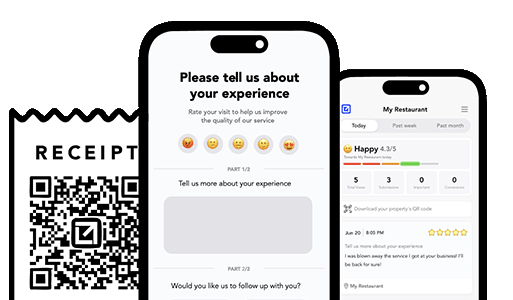
How can I prevent negative reviews from hurting my business? You can’t stop every unhappy customer from sharing feedback, but you can intercept it before it goes public. Tools like VisibleFeedback allow customers to scan a QR code and leave feedback privately. If the feedback is negative, you’re alerted instantly so you can resolve the issue before it turns into a 1-star review.
Why are customer reviews so important for local SEO? Reviews are one of the top local ranking factors on Google. Businesses with consistent positive reviews rank higher in search results and attract more customers. By using VisibleFeedback to capture happy customer moments and guide them to Google or Yelp, you build a steady flow of authentic reviews that improve both your reputation and your local SEO.
What’s the best way to collect customer feedback in 2025? Traditional methods like comment cards and long surveys don’t work anymore, customers want convenience. The easiest way to collect real-time feedback in 2025 is by using QR codes and mobile-friendly forms. VisibleFeedback makes this simple, helping you get instant insights while turning satisfied customers into 5-star reviewers.
How can I get more positive reviews? The key to getting more positive reviews is asking at the right moment, when the customer is satisfied and the experience is still fresh. With tools like VisibleFeedback, you can use smart prompts, follow-up messages, and QR codes to make it easy and natural for happy customers to leave a review, while privately capturing negative feedback before it goes public. For a full breakdown of proven strategies, check out our guide on how to get more reviews.
What’s the fastest way to handle negative reviews? Respond quickly, stay professional, and try to resolve the issue privately if possible. Negative feedback is often a chance to turn frustration into loyalty, if you act fast. Tools like VisibleFeedback help by catching complaints before they go public. For a full playbook on how to handle bad reviews and protect your reputation, check out our guide on what to do when you get negative feedback.
Do private feedback tools really work? Yes, customers prefer private channels to share complaints. VisibleFeedback captures these insights and helps you turn unhappy customers into loyal ones.
Authored by Austin Spaeth

Austin Spaeth

Austin Spaeth is the founder of VisibleFeedback, a tool that helps service companies automate post-job follow-ups, catch issues early, and drive repeat work with smart reminders. With a background in software development and a focus on practical customer retention systems, Austin built VisibleFeedback to make it easy to email customers after every job, route problems to the right person, and keep relationships strong without awkward outreach. When he’s not building new features or writing playbooks for service businesses, he’s wrangling his six kids or sneaking in a beach day.

🚀 What's your goal? Get a plan ...

🚀 Start Here For Help

Whether you’re dealing with callbacks, unhappy customers, or low repeat work, we’ll help you tighten the follow up loop.

Begin Beginning
Next article
×

👋 Wait! Before You Go

Send your first follow up today! Catch issues early and drive repeat work.

No credit card required.