8/7/2025
Reviews
Smart Ways to Get More Reviews [Guide]
Practical, proven ways for any business to get more authentic reviews.

TLDR: Managing reviews across multiple locations is a monitoring and routing problem, not a software-budget problem. Customers never see your company average; they see the one rating for the store nearest them, so a single weak location quietly loses you business in its whole area. The fix is three habits: track each location’s rating, volume, and review recency on its own, catch unhappy customers privately before they post in public, and route every complaint to the manager who actually owns that site. You can run the whole thing on a shared sheet, or automate it for a fraction of what the enterprise platforms charge. Below is the full system, a weekly scorecard, the routing rules, and a comparison of your real options.
When you had one location, reputation was simple. One Google listing, one rating, one inbox. You felt the pulse of the business without trying.
Add a second, third, or fourth location and something sneaky happens. You start watching the company-wide average, but no customer ever sees that number. A customer searching “oil change near me” sees the one listing closest to them, judged entirely on that store’s own rating and reviews. Your shiny flagship with a 4.9 does nothing for the customer standing two towns over, looking at your 3.8 satellite shop.
So the real risk of multiple locations is not that your average dips. It is that the average hides the spread. Three strong stores can mask one that is quietly sliding, and that weak store is losing you calls, clicks, and foot traffic in its entire zip code while your dashboard says everything is fine.
Managing reviews across multiple locations means treating each site as its own reputation, then watching all of them from one place. That is the whole game. You do not need a six-figure software contract to do it. You need the right scoreboard and the right habits.
Before you change anything, you need to see the truth. The fastest way is a simple scorecard with one row per location, updated once a week. You can keep it in a spreadsheet; it takes about ten minutes.
Track four numbers for each site:
Here is what a healthy scorecard looks like, with the problem jumping right out:
| Location | Rating | Total reviews | Newest review | New this week | Flag |
|---|---|---|---|---|---|
| Northside | 4.8 | 212 | 2 days ago | 4 (0 neg) | Healthy |
| Westgate | 4.7 | 168 | 5 days ago | 3 (0 neg) | Healthy |
| Downtown | 3.9 | 54 | 1 day ago | 5 (3 neg) | Needs attention |
| Eastvale | 4.6 | 97 | 11 days ago | 0 | Going quiet |
Two problems surface instantly. Downtown is taking fresh one-star hits right now, and Eastvale has gone silent for eleven days. Neither would show up if you only watched the company average of 4.5. The scorecard turns an invisible problem into an obvious one.
Monitoring tells you a location is slipping. It does not stop the slip. For that you need to get in front of unhappy customers before they reach a public review box.
The single highest-leverage habit for any local business, and it compounds hard across multiple locations, is a private check-in after every job or visit. You send a short message that asks how things went. Unhappy customers reply to you, privately, so you can fix the problem before it becomes a public one-star. Happy customers get pointed to that location’s Google listing, feeding its rating and recency. This is the core idea behind a feedback funnel, and across a multi-location business it does two jobs at once: it lifts every location’s rating and it gives you a private, per-location stream of problems to act on.
The catch with multiple locations is that a single generic check-in is not enough. A customer at your Downtown store should get a message that reads like it came from Downtown, points to the Downtown Google listing, and routes any complaint to the Downtown manager. Branded, location-aware messaging is what keeps this from feeling like a faceless corporate blast.
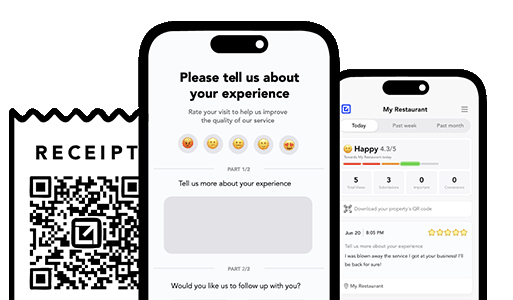
Tools like VisibleFeedback intercept dissatisfaction before it turns into a public review, and across locations that private channel is what keeps your weak store from becoming your famous store. You get an instant alert the moment a customer at any site is unhappy, which turns a would-be one-star into a fixable phone call.
This is where multi-location operations quietly fall apart. A complaint comes in, it lands in one central inbox, and everyone assumes someone else will handle it. Nobody does. The customer waits, gets angrier, and posts the review you were trying to prevent.
The rule is simple: a complaint about a location goes to the person responsible for that location, with a clear owner and a clock on it. Not to a shared address nobody checks. Not to you, the owner, who is already stretched across every site. To the Downtown manager, for the Downtown problem, now.
A clean routing setup looks like this:
That last point is the balance you are after. Decentralize the response so problems get handled fast and locally. Centralize the visibility so nothing slips past you.

When owners go looking for a tool, they usually hit two extremes: a free-but-manual spreadsheet, or an enterprise reputation suite with a salesperson and an annual contract. Here is the honest comparison.
| Manual spreadsheet | Enterprise suite | Private-first tool | |
|---|---|---|---|
| Per-location scorecard | Yes, by hand | Yes | Yes, automatic |
| Catches problems before they post | No | Sometimes | Yes, built around it |
| Routes complaints to the right manager | Manual, easy to drop | Yes, complex setup | Yes, simple rules |
| Recurring reminders to drive repeat visits | No | Add-on | Yes |
| Setup effort | Low | High, onboarding call | Low |
| Contract | None | Usually annual | None |
| Typical cost | Free, but costs time | $299 to $699 per month | From about $65 per month |
The enterprise platforms are genuinely powerful, and for a 50-location chain with a marketing department they can make sense. But if you run two to ten locations, you are paying for a dashboard with a hundred features you will never touch, on a contract you cannot leave. Most multi-location small businesses do not have a review-volume problem that needs enterprise software. They have a monitoring and routing problem that needs a simple, consistent system.
VisibleFeedback was built to catch issues before they show up on Yelp or Google, to route them to the right person at the right location, and to keep recurring reminders going so past customers come back. It does the three jobs that actually matter for multiple locations, at a price and a commitment level that fits a small operation: affordable, and no contract.
Reviews are the visible half of reputation. Repeat business is the half that pays the bills. Across multiple locations, the same system that protects your ratings can also drive people back through the door.
Recurring reminders, a seasonal nudge, a “time for your next service” message, a check-in a few months after a big job, bring past customers back to the specific location they used. That creates a fresh visit, which creates a fresh review opportunity, which keeps that location’s recency signal strong. It compounds, store by store. For the full loop, see how post-job follow-ups turn one-time jobs into ongoing relationships, and how a win-back campaign pulls back customers who have gone quiet. Run that at every location and your weakest store has a path back to healthy, not just a Band-Aid on its rating.
Short on time? Do these today and you will already be ahead of most multi-location operators:
Should I use one Google listing for all my locations or separate ones? Separate listings, always. Each physical location needs its own Google Business Profile with its own address, hours, and reviews. That is how customers find the store nearest them, and it is Google’s requirement. Managing reviews across locations means managing several listings, not merging them.
Why not just watch my company-wide average rating? Because no customer sees it. Google shows the rating of the specific location they searched for. A healthy average can hide one weak store that is losing you business in its entire service area. Track each location on its own.
Can I manage multiple locations without paying for software? Yes, with a shared scorecard and clear routing rules, you can run the whole system by hand. It costs time rather than money, and it works. The reason owners automate it is consistency: a manual process slips the first busy week, and slipped follow-ups are exactly how one-star reviews happen.
How do I keep managers accountable for their location’s reviews? Give each manager ownership of their site’s feedback and a clear response target, then keep the per-location scorecard visible to everyone. When the newest-review date and the new-negatives count sit side by side across all locations, a quiet or slipping store cannot hide. Visibility does most of the accountability work for you.
What is the fastest way to lift a weak location’s rating? Get in front of unhappy customers privately so they stop posting one-stars, and make it effortless for happy customers to leave a review. A post-visit check-in does both at once. Pair it with fast, local recovery on every complaint and the weak store’s recency and average both climb within weeks.
Multiple locations do not make reputation harder because there are more reviews. They make it harder because the one that matters, your weakest store, is the easiest to miss. Watch each location on its own, catch problems privately before they post, and route every complaint to the manager who owns that site. That system does not require an enterprise contract. It requires a scoreboard and a habit, and it keeps every one of your locations competing for the top of its own local search.
Start a free 14-day trial of VisibleFeedback, no credit card required, and watch every location catch its own problems privately while you keep the bird’s-eye view.
Email clients after every job. Catch issues early, recover unhappy clients fast, and drive repeat work with smart reminders.

Austin Spaeth is the founder of VisibleFeedback, a tool that helps service companies automate post-job follow-ups, catch issues early, and drive repeat work with smart reminders. With a background in software development and a focus on practical customer retention systems, Austin built VisibleFeedback to make it easy to email customers after every job, route problems to the right person, and keep relationships strong without awkward outreach. When he’s not building new features or writing playbooks for service businesses, he’s wrangling his six kids or sneaking in a beach day.
Whether you’re dealing with callbacks, unhappy customers, or low repeat work, we’ll help you tighten the follow up loop.
No credit card required.
