8/7/2025
Reviews
Smart Ways to Get More Reviews [Guide]
Practical, proven ways for any business to get more authentic reviews.

TLDR: There’s no universal magic number of Google reviews. The right number is whatever it takes to beat the top competitors in your own local search results, paired with a rating in the 4.2 to 4.8 range and a steady stream of recent reviews. For most local businesses that means crossing 10 reviews to reach the trust threshold, reaching 25 to 50 to look genuinely competitive, and adding a handful of fresh reviews every month so you never look stale. Below is how to find your real target, the volume and recency benchmarks that matter, and a simple follow-up system to get there without ever begging a customer.
“How many Google reviews do you need?” is one of the most common questions local business owners ask, and it usually comes with a hope that someone will just say a number. Forty. A hundred. Some clean target you can hit and be done.
I get why people want that. It would be tidy. But the honest answer is that the number that matters is not on any chart, it’s sitting in the search results your customers already look at, and it’s different for a dentist in Chicago than for a septic company in a rural county. The good news: once you know how to read it, your target becomes obvious, and it stops feeling like an impossible mountain.
Let me give you the real answer, the benchmarks that hold up almost everywhere, and how to actually get there.
The number of Google reviews you need is whatever it takes to look like the obvious choice next to your direct competitors in local search. That is the whole answer, and everything else is detail.
Reviews do not exist in a vacuum. A shopper never sees your review count on its own. They see it lined up against two or three other businesses in the Google map pack, and their brain does a quick, unconscious comparison. More reviews, recent, at a solid rating, reads as “this is the safe pick.” Fewer, older, or lower reads as “risky.” You are not trying to hit a magic number, you are trying to win that side-by-side glance.
So the question is not “how many reviews are enough,” it’s “enough compared to whom?” And that you can measure in about five minutes.
Skip the guesswork and go look at the scoreboard your customers use.
If the top three in your market have 60, 45, and 30 reviews, your target is not “get more reviews someday,” it’s “get past 60, and keep going.” If they have 400, 380, and 210, that’s a different and steeper hill, but at least now you know the grade instead of guessing.
Your market decides the exact target, but a few thresholds show up again and again across local businesses. Use these as guardrails.
| Review count | What it signals | What to do |
|---|---|---|
| 0 | You look brand new or inactive. Many shoppers won’t risk it. | Get your first 5 reviews this month, from your happiest recent customers. |
| 1 to 9 | You’re below the point where most people trust the star rating. A single bad review swings your whole average. | Push hard to cross 10. This is the highest-leverage stretch you’ll ever have. |
| 10 to 24 | Consumers start believing the rating. Studies consistently show people read around 10 reviews before forming an opinion. | Keep the flow going and watch your competitors’ counts. |
| 25 to 50 | You look established and competitive in most local markets. | Maintain velocity so you don’t slide back down the list. |
| 100+ | You’re the category leader. New competitors can’t easily catch up. | Protect it. Keep asking, keep responding, keep it fresh. |
The single most valuable stretch is getting from zero to your first 10 reviews. That’s where you cross from “unknown” to “trusted enough to call.” Going from 40 to 50 barely moves a shopper. Going from 4 to 14 changes whether they trust you at all.
Review count is only one leg of the stool. Two businesses with the same number of reviews can send completely different signals. Here’s how the three factors trade off.
Here’s a truth that trips people up: a perfect 5.0 star rating can actually hurt you once you have more than a few reviews. Shoppers have learned that a spotless 5.0 often means the reviews were cherry-picked or fake. A 4.2 to 4.8 rating reads as real, and businesses in that band frequently convert better than flawless ones. So don’t panic over the occasional 4-star. A few honest imperfect reviews make the whole profile believable.
And this is why volume protects you. With 6 reviews, one angry 1-star drags your average down to 4.3 overnight. With 90 reviews, that same 1-star barely registers. A 4.7 rating from 90 reviews beats a 5.0 from 6 every time, because it looks proven instead of lucky.
This is the factor most owners ignore. Reviews have a shelf life. A shopper reading your profile mentally discounts anything older than a few months, and a wall of glowing reviews that all stopped 18 months ago actually raises a red flag: what happened to this business? Google appears to weigh fresh reviews more heavily too when ranking local results.
The practical takeaway: a steady trickle beats a one-time flood. Ten reviews spread across the last three months signals a healthy, active business far better than 40 reviews that all landed during one campaign two years ago. Which means your real target isn’t just a total, it’s a monthly pace.
Enough to keep climbing and stay fresh. A simple rule for most local businesses:
If you complete even 15 to 20 jobs a month and ask every satisfied customer, these numbers are very reachable. Most businesses fall short not because customers won’t leave reviews, but because nobody asks consistently.

Knowing your target is the easy part. Hitting it comes down to one thing: asking every happy customer, every time, at the right moment. Not when you remember. Every time.
Here’s the system that works for local businesses:
This is where the review count problem quietly solves itself. When every completed job triggers a private check-in and a routed review ask, your count climbs on its own, your rating stays honest because you’re catching problems early, and your recency takes care of itself because reviews arrive every week. VisibleFeedback was built to run exactly this loop, catching issues before they show up on Google or Yelp and steering your happy customers toward public reviews, starting at $65 a month with no contract.
For the wording and timing of the asks themselves, this walkthrough on how to get more Google reviews for your service business covers the scripts, and getting more 5-star reviews without begging covers the mindset.
Print this, or just work down it:
How many Google reviews do I need to rank in the map pack? There’s no fixed number, because ranking depends on relevance, distance, and your overall profile, not review count alone. Practically, you want to at least match the review counts of the businesses currently in your local map pack, keep a steady flow of recent reviews, and maintain a strong rating. Review volume and recency are meaningful ranking signals, but they work alongside proximity and relevance, so a competitor closer to the searcher may still outrank you with fewer reviews.
Is it better to have more reviews or a higher rating? Both matter, but past a certain point volume wins, as long as your rating stays healthy. A 4.7 from 90 reviews beats a 5.0 from 6, because it reads as proven rather than lucky. Aim for a rating in the 4.2 to 4.8 band and then focus on steadily growing your count.
Do old Google reviews still count? They still count toward your total and your average, but shoppers and Google both appear to give more weight to recent reviews. A profile where the newest review is 18 months old looks inactive. That’s why a steady monthly pace matters more than a one-time push.
How many reviews should I get per month? If you’re under 25 total, aim for 4 to 8 a month to cross the trust threshold quickly. Once you’re established, 3 to 5 a month keeps your profile looking fresh and active. Match or beat your nearest competitor’s recent pace.
Do I need reviews on Yelp and other sites too, or just Google? Google is the priority for most local businesses because it’s where the most searches happen, but a presence on the platforms your customers actually use adds credibility. For most trades that’s Google first, then whichever secondary site matters in your niche. More on that in Google vs. Yelp: why you need 5-star reviews on both, and on why a low count quietly costs you traffic in this breakdown of review volume.
Stop looking for a magic number. The right number of Google reviews is the one that makes you the obvious choice next to your competitors, at a rating that reads as real, refreshed often enough that you always look active. Find your benchmark in five minutes, set a monthly pace, and put a follow-up system in place that asks every happy customer automatically. Do that, and the count stops being something you chase and becomes something that just keeps climbing.
Start a free 14-day trial of VisibleFeedback, no credit card required.
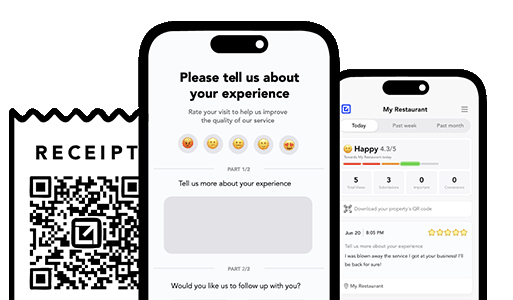
Email clients after every job. Catch issues early, recover unhappy clients fast, and drive repeat work with smart reminders.

Austin Spaeth is the founder of VisibleFeedback, a tool that helps service companies automate post-job follow-ups, catch issues early, and drive repeat work with smart reminders. With a background in software development and a focus on practical customer retention systems, Austin built VisibleFeedback to make it easy to email customers after every job, route problems to the right person, and keep relationships strong without awkward outreach. When he’s not building new features or writing playbooks for service businesses, he’s wrangling his six kids or sneaking in a beach day.
Whether you’re dealing with callbacks, unhappy customers, or low repeat work, we’ll help you tighten the follow up loop.
No credit card required.
