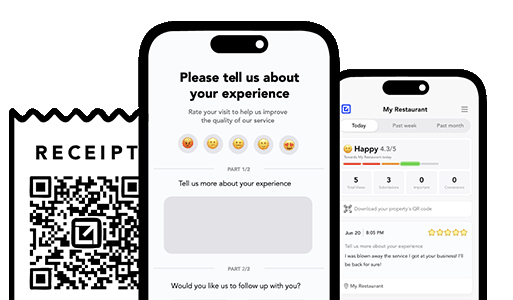
TLDR: Most owners hate monthly software fees because they’ve been burned by tools that promise “more leads” and deliver vague charts. A follow-up system is different because the ROI is mechanical: you save jobs that would’ve churned, prevent callbacks that waste labor, and convert satisfied customers into repeat work and reviews. You don’t need hand-wavy math. You need a simple model: what’s one saved job worth, how often do you currently lose customers to unresolved issues, and how many negative moments can you catch with a fast one-tap follow-up? This article gives a practical calculator you can do in your head, realistic scenarios for small teams, and break-even examples for $99–$199/month. The punchline: if a follow-up system prevents even one lost customer or one callback every month, it’s often already profitable. VisibleFeedback exists to run that loop automatically—one-tap feedback, instant alerts, recovery workflow, and safer review asks—so the savings happen consistently without the owner babysitting it.
Why This ROI Model Is Different (No “More Leads” Fairy Dust)
Most SaaS pitches for small service businesses are basically:
- “Pay us $199/mo and you’ll get more leads.”
- “Trust us. Look at this graph.”
That’s why owners tune out. It’s not that $199 is expensive. It’s that the payoff is usually vague.
Follow-ups have a cleaner ROI because they operate on things you already have:
- customers you already worked for
- jobs already completed
- issues that already happen
- callbacks you already eat
- reviews you already depend on
The question isn’t “will it magically create demand?”
The question is “how much money leaks today because issues slip and customers churn?”
The “Saved Job” Mental Model
A saved job is any situation where:
- the customer would’ve churned, complained publicly, or demanded a refund
- but a fast follow-up caught it early and you fixed it
This includes:
- small complaints that turn into bad reviews
- “the problem came back” that becomes a callback + reputation hit
- misunderstandings that become chargebacks
- installs where a minor tweak prevents regret and cancellation of a maintenance plan
A follow-up system doesn’t need to produce 50 extra jobs. It just needs to save a few you were going to lose anyway.
Step 1: Know Your “One Saved Job” Value
You can compute this without a spreadsheet. Pick one of these approaches.
Option A: Profit per job (the cleanest)
One saved job is worth the profit you would’ve made on that customer’s next job.
- Saved job value ≈ average gross profit per job
If you don’t know gross profit, use a rough number. Most owners do. Even a conservative estimate works.
Option B: Customer lifetime value (if you have recurring opportunity)
If you do maintenance plans or repeat services, one saved customer is worth more than one job.
- Saved customer value ≈ profit on next 12 months of work
This can be surprisingly high for HVAC, pest control, and any recurring service.
Option C: “Avoided refund/credit” value
Sometimes the “save” is avoiding a refund, discount, or chargeback.
- Saved value ≈ refund/credit you avoid + the job margin you keep
Step 2: Add Callback Avoidance (The Hidden ROI)
Callbacks are straight cash burn:
- another trip
- more labor
- schedule disruption
- often a worse review risk
A callback doesn’t just cost gas. It costs capacity.
A simple callback cost estimate:
- Callback cost ≈ (labor hours × loaded hourly cost) + travel/overhead
If you don’t know loaded cost, estimate it. The point is directionally correct.
Even preventing one callback per month can justify $99–$199 easily for many teams.
Step 3: Use the Break-Even Rule (Simple and Honest)
Here’s the core “calculator”:
Break-even = monthly cost / value per save
Where “value per save” can be:
- one saved job profit, or
- one avoided callback cost, or
- one saved customer’s next 12-month profit (if recurring)
Break-even examples (no fluff)
If a tool costs $99/mo:
- If one saved job is worth $300 profit → you only need 0.33 saves/mo (one save every 3 months)
- If one avoided callback costs you $200 → you need ~0.5 avoided callbacks/mo (one every 2 months)
If a tool costs $199/mo:
- If one saved job is worth $400 profit → you need ~0.5 saves/mo (one save every 2 months)
- If one avoided callback costs you $250 → you need ~0.8 avoided callbacks/mo (one per month)
This is the whole point: the bar is often low.
A Practical “In Your Head” Calculator
Ask yourself three questions:
1) What’s your average profit on a job?
2) How many customers per month end up unhappy enough to complain, churn, or leave a bad review?
3) If you could catch and fix even a fraction of those quickly, how many would you save?
Then do this:
Monthly ROI estimate ≈ (saved jobs × profit per job) + (avoided callbacks × callback cost)
If that number is above $99–$199, the tool is already paying for itself.
Three Realistic Scenarios (Small Teams, Realistic Numbers)
Scenario 1: The “One Save” Business
- 80 jobs/month
- You get 3–5 “unhappy moments” per month (late tech, miscommunication, incomplete fix)
- Profit per job: $300
- Tool cost: $99/mo
If fast follow-ups save just 1 job every 2–3 months:
- Saved value per month ≈ $100–$150 You’re already break-even.
Scenario 2: The Callback Leak
- 120 jobs/month
- Callbacks: 5/month
- Each callback costs you ~$200 in labor/time/overhead
- Tool cost: $199/mo
If follow-ups prevent 1 callback per month (by catching “problem isn’t fixed” early):
- Saved value per month ≈ $200 Break-even.
If it prevents 2 callbacks:
Scenario 3: The Recurring Opportunity (HVAC / Pest)
- You sell maintenance/recurring plans
- One saved customer converts into recurring value over the next year
- That value might be $600–$1,500+ profit depending on your model
- Tool cost: $99–$199/mo
If follow-ups help you save 1 customer per quarter and convert them to repeat work:
- Break-even is almost automatic.
The recurring model is where follow-ups can be absurdly high ROI, without needing wild claims.
Why Follow-Ups Actually Create “Saves”
A save usually happens when you do three things consistently:
1) Ask for feedback in a way customers will actually respond to (one-tap)
2) Respond fast when someone is unhappy (minutes/hours, not days)
3) Close the loop (confirm it’s resolved)
Most businesses fail at #2 and #3 because the owner is busy. That’s the whole reason this category exists.
What a Follow-Up System Should Do (If It’s Worth Paying For)
If you’re considering spending $99–$199/mo, the tool should do more than “send messages.”
It should:
- trigger follow-ups automatically after jobs
- make feedback extremely low-friction
- alert you instantly on negative signals
- track status (New → Acknowledged → Contacted → Resolved)
- help you confirm resolution
- make review asks safe and consistent
If it doesn’t do those things, it’s just another messaging tool with a subscription.
Where VisibleFeedback Fits (And Why It’s Not Hand-Wavy)
VisibleFeedback is built around the mechanical ROI model above:
- one-tap feedback capture increases response rates
- negative feedback triggers alerts so you can respond before it goes public
- issue tracking statuses keep problems from slipping
- confirmation closes the loop so “resolved” actually means resolved
- review asks happen in a safer, more professional way
That makes “saves” more frequent and more consistent, which is the real lever.
Bottom Line
Don’t buy follow-up software because someone promised “more leads.”
Buy it if you believe this is true in your business:
- customers sometimes leave unhappy without telling you
- you sometimes find out too late
- callbacks waste labor
- repeat work and reviews depend on trust
If a system helps you save even one job or one callback per month, $99–$199/mo usually pays for itself. The rest is upside.