TLDR: Lawn care customer retention comes down to one habit: follow up after every treatment. A short check-in tells you which lawns are thriving and which customers are quietly frustrated, before they cancel or leave a one-star review. Send an after-treatment message, route any problem to a tech fast, and use seasonal reminders to line up the next round. That single loop protects your recurring revenue better than any discount.
Lawn care is one of the best recurring-revenue businesses in home services. A customer on a full program buys six or seven treatments a year, for years, and refers the neighbors. That is also exactly why lawn care customer retention matters more than the next new sale. Losing one program customer in March quietly erases the margin from three one-time cleanups. And here is the part that catches owners off guard: most of the customers you lose never complained. They just went quiet.
Why do lawn care customers really cancel?
If you ask around, everyone assumes it is price. When you look at the actual reasons people leave, price is rarely at the top. Lawn care has a few churn drivers that are specific to the trade:
Results are slow, so doubt creeps in. A treatment that is working perfectly can still look imperfect two weeks later. The customer sees a few weeds or a dry patch, decides “this is not working,” and starts shopping. You never get the chance to explain that weed pressure spikes after rain, or that the pre-emergent is doing its job underground.
They forget what you did. The tech came while they were at work. There is no note, no text, no proof anything happened. To the customer it can feel like they paid for an invisible service.
A small problem went unheard. Burn spots, a skipped section, a gate left open, the dog got out. Minor stuff you would happily fix, if you only knew about it.
Nobody reached out. This is the big one. Silence between treatments reads as “they do not care.” When a competitor knocks on the door with a spring offer, there is no relationship holding the customer in place.
Notice that almost none of these are about the quality of your chemistry or your technicians. They are about communication. That is good news, because communication is the cheapest thing to fix. The same pattern shows up in every recurring trade; it is the reason landscaping clients ghost after one season too.
The lawn care follow-up system that keeps customers on plan
The whole system is one loop repeated after every visit: leave proof you were there, check in a couple of days later, act on what you hear, then remind before the next round is due. None of it takes long, and it works whether you run two trucks or twenty.
1. Leave proof at every visit
Before the follow-up text ever goes out, make the service visible. A door hanger or a quick digital note that says what you applied, what you noticed, and what the customer should do next (“watered in, avoid mowing for 48 hours, expect weeds to brown in 7 to 10 days”) does two things. It kills the “I paid for nothing” feeling, and it sets expectations so slow results do not read as failure.
2. Send a short check-in a couple of days later
Wait two or three days after the treatment, long enough for the customer to have walked the yard, then send one simple message. Not a survey. One question. The goal is to open a door, not to grade yourself. This is the same post-job follow-up discipline that reduces callbacks across every service trade.
3. Route any problem to a tech the same day
When someone replies that the lawn looks off, that is not a complaint, it is a save. Get the detail, decide if it is a re-treat or an explanation, and get a tech back out fast if needed. A customer whose burn spot you fixed in three days is more loyal than one who never had a problem. Speed is the whole game here.
4. Ask happy customers for a review
If the reply is positive, that is your moment. A lawn that looks great and an owner who just told you so is the highest-converting review ask you will ever get. Send the Google link right then. This is how a retention system quietly doubles as a review engine.
5. Remind before the next treatment is due
The renewal is not a separate sale, it is the next loop. A reminder that the next application is coming up, tied to the season (“crabgrass pre-emergent goes down when soil temps hit the 50s, we would like to schedule you”), keeps the customer on plan and positions you as the expert who is watching their lawn for them. Recurring reminders are the backbone of turning one-time jobs into repeat work.
What silence actually costs you
It helps to see the two paths side by side. Same lawn, same slightly-imperfect result two weeks after a treatment. The only difference is whether anyone followed up.
Moment
No follow-up
With a follow-up system
Customer sees a few weeds
Assumes it is not working
Gets a note that weeds brown in 7 to 10 days
Customer is annoyed
You never hear about it
They reply to your check-in
A real problem exists
Festers until they cancel
Tech is back out in days
Customer is happy
Stays silent
Leaves a Google review
Renewal comes due
They have already left
Seasonal reminder books it
Bad experience
Shows up as a one-star
Handled privately, never posted
The no-follow-up column is not a worst case. It is the default when nobody is minding the gap between treatments.
Copy-and-paste follow-up templates
Keep these short and human. The point is a reply, not a polished paragraph.
After-treatment check-in (SMS, send day 2 to 3):
Hi [Name], [Tech] treated your lawn on [day]. Give it a week or so for the weeds to brown out. How is it looking so far, any spots you want us to look at?
Happy reply, review ask:
Love to hear it, thank you! If you have 30 seconds, a quick Google review really helps other neighbors find us: [review link]
Problem reply, ownership:
Thanks for telling me, I want this right. I am getting [Tech] back out to [re-treat / check the spot] this week. I will text you once it is scheduled.
Seasonal renewal reminder (before next cycle):
Hi [Name], your lawn is due for its [spring pre-emergent / summer feeding / fall aeration] soon. Want me to get you on the schedule for the week of [date]?
How to catch problems before they become bad reviews
Here is the version of the funnel that protects your rating. If your only outreach is “please leave us a review,” you are handing a megaphone to the exact customers who are frustrated. The smarter move is to ask a private question first. Happy customers get pointed to Google. Unhappy customers reach you, in private, where you can fix the lawn instead of arguing in the reviews. This private-first approach is the core idea behind feedback funnels.
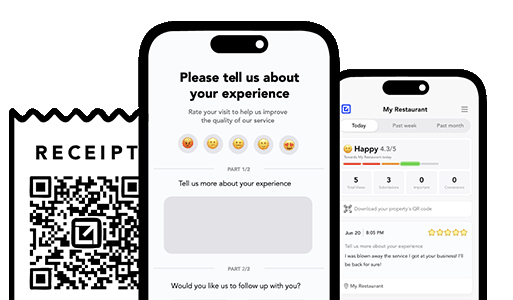
Doing this by hand after every stop on a full route is where the good intention dies. The truck is behind, the office is slammed, and the follow-up slips, so the only people who bother to post are the angry ones. This is the gap that tools like VisibleFeedback are built to close. It automatically texts or emails each customer after the treatment, catches the unhappy ones privately before they reach Google, routes the issue to the right person for a fast fix, and points the happy ones to your review link. VisibleFeedback was built to catch issues before they show up on Yelp or Google, and to run the seasonal reminders that book the next treatment, all on autopilot. It starts at $65 a month with no contract, a fraction of what the big reputation suites charge.
Automate follow ups after every job
Catch issues early and drive repeat work with smart reminders.
The retention win and the revenue win are the same motion. Every automated check-in is a touchpoint that reminds the customer you exist, and every seasonal reminder is a soft renewal that does not feel like a sales call. Owners who run this loop consistently see two things move together: fewer cancellations, because problems get caught early, and more upsells, because a customer who trusts you is an easy yes on aeration, overseeding, or grub control. A frustrated customer you never heard from buys nothing. A happy one on a reminder cadence buys all season, every season.
Frequently asked questions
How soon after a lawn treatment should I follow up? Two to three days is the sweet spot. It is long enough that the customer has walked the yard and noticed how it looks, but early enough that if something is wrong you can still send a tech back before frustration sets in.
Text or email for lawn care follow-ups? Text gets read and replied to far more often, which is what you want for a quick check-in. Email is fine for longer seasonal reminders or attaching a treatment plan. Many owners use text for the check-in and email for the schedule-ahead reminders.
Will follow-up messages annoy my customers? Not if they are useful and infrequent. One short check-in after a treatment and a reminder before the next one is help, not spam. The line you do not want to cross is asking for a review over and over. Ask once, and only after you know they are happy.
How does this actually reduce bad reviews? It gives the unhappy customer a private place to vent before they reach a public one. Most one-star reviews come from people who felt ignored, not from people you could never please. When you catch the complaint yourself and fix it fast, the review either never gets written or turns positive. For the few that still land, here is how to respond to bad reviews without making it worse.
What is the single highest-impact change if I only do one thing? Send one after-treatment text to every customer, every visit. That one habit surfaces problems, generates reviews, and keeps you in front of the customer. Everything else in this article is an upgrade on that foundation.
The bottom line
Lawn care lives and dies on the second year, not the first sale. The customers you keep are worth many times the ones you win, and you keep them by closing the silent gap between treatments. Leave proof you were there, check in a few days later, fix what you hear about fast, and remind before the next round. Do that consistently and cancellations shrink, reviews climb, and your route compounds instead of leaking.
If you would rather not run all of that by hand after every stop, start a free 14-day trial of VisibleFeedback, no credit card required. It handles the after-treatment check-ins, the private issue routing, and the seasonal reminders so your customers stay on plan and your best lawns turn into reviews.
Automate follow ups after every job
Catch issues early and drive repeat work with smart reminders.
How can I prevent negative reviews from hurting my business? You can’t stop every unhappy customer from sharing feedback, but you can intercept it before it goes public. Tools like VisibleFeedback allow customers to scan a QR code and leave feedback privately. If the feedback is negative, you’re alerted instantly so you can resolve the issue before it turns into a 1-star review.Why are customer reviews so important for local SEO? Reviews are one of the top local ranking factors on Google. Businesses with consistent positive reviews rank higher in search results and attract more customers. By using VisibleFeedback to capture happy customer moments and guide them to Google or Yelp, you build a steady flow of authentic reviews that improve both your reputation and your local SEO.What’s the best way to collect customer feedback in 2025? Traditional methods like comment cards and long surveys don’t work anymore, customers want convenience. The easiest way to collect real-time feedback in 2025 is by using QR codes and mobile-friendly forms. VisibleFeedback makes this simple, helping you get instant insights while turning satisfied customers into 5-star reviewers.How does feedback help improve retention? Feedback reveals what keeps customers loyal and what drives them away. VisibleFeedback helps you act on insights before customers churn.What’s the link between customer experience and retention? Positive experiences lead to repeat business. Using tools like VisibleFeedback ensures you consistently deliver great experiences by resolving issues early.Why should businesses prioritize retention over acquisition? Retaining customers is cheaper and more profitable than finding new ones. VisibleFeedback helps strengthen retention by keeping customers satisfied.
Austin Spaeth is the founder of VisibleFeedback, a tool that helps service companies automate post-job follow-ups, catch issues early, and drive repeat work with smart reminders. With a background in software development and a focus on practical customer retention systems, Austin built VisibleFeedback to make it easy to email customers after every job, route problems to the right person, and keep relationships strong without awkward outreach. When he’s not building new features or writing playbooks for service businesses, he’s wrangling his six kids or sneaking in a beach day.
🚀 What's your goal? Get a plan ...
🚀 Start Here For Help
Whether you’re dealing with callbacks, unhappy customers, or low repeat work, we’ll help you tighten the follow up loop.