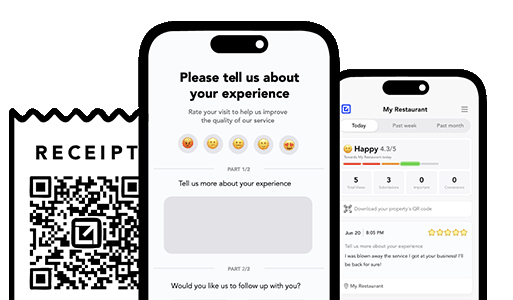
TLDR: Most service businesses lose repeat work (and get blindsided by bad reviews) for a dumb reason: they don’t have a follow-up system that customers will actually use. Long surveys get ignored. Phone calls go to voicemail. And by the time you find out someone is unhappy, it’s already public on Google. The fix is the one-tap model: a single question that takes 2 seconds to answer, sent at the right time, with a smart branching path. Happy customers get funneled into reviews and rebooking. Unhappy customers get a private outlet and a fast response—before they torch you online. This article breaks down a simple post-job follow-up loop you can run for HVAC, pest control, home services, clinics, and any appointment-based business. You’ll get the exact steps, timing, copy, and routing rules. And if you want it automated end-to-end, VisibleFeedback is built to run this loop: one-tap feedback capture, instant alerts, issue triage, and review generation—without annoying customers or risking your reputation.
🔁 Why “Follow Up After the Job” Usually Fails
Most businesses technically “follow up.” They just do it in a way that guarantees low response.
Common failure modes:
- They ask for a review immediately. That’s how you convert a mild annoyance into a 1-star essay.
- They send a long survey. Nobody wants homework after paying you.
- They rely on a phone call. People don’t answer unknown numbers, and if they do, they’ll say “everything’s fine” to get off the phone.
- They wait too long. By day three, the customer has already decided how they feel—and if they’re annoyed, they’ve already told Google.
This creates a predictable pattern:
- Job gets completed
- Customer has a minor frustration (or a major one)
- No easy private outlet exists
- Customer vents publicly
- You find out too late, and now you’re doing damage control
The post-job follow-up loop fixes that by making feedback frictionless and routing it before it becomes a public problem.
✅ The One-Tap Model (The Core Idea)
The one-tap model is exactly what it sounds like: a single question with a single tap. No typing. No login. No survey.
Example:
“How did we do today?” 🙂 Great / 😐 Okay / 🙁 Not good
Or:
“Was everything handled the way you expected?” Yes / No
That’s it. The “magic” isn’t the question. It’s the branching logic behind it.
- If they’re happy → guide them to a review and/or repeat work
- If they’re not → capture the issue privately and trigger a fast response
This works because it matches real customer behavior:
- People will tap a button
- People will not fill out a form unless they’re angry (and if they’re angry, that’s dangerous)
- People don’t want confrontation, they want to feel heard and see action
🧠 What the Loop Actually Does (Complaints, Jobs, Repeat Work)
A good follow-up loop does three jobs at once:
1) Reduces complaints (by giving a private outlet). If you make it easy to complain privately, you stop a chunk of public complaints from ever happening.
2) Saves jobs (by catching issues while they’re fixable). In service businesses, “bad experience” often means one of these:
- The tech was rushed or messy
- Communication was unclear
- The issue wasn’t fully solved
- Price expectations weren’t aligned
- Scheduling was annoying
Many of these are salvageable if you learn about them within hours, not days.
3) Creates repeat work (by converting satisfaction into momentum). Happy customers are most likely to:
- Book maintenance plans
- Schedule the next service
- Refer you
- Leave a review …but only if you give them a clear next step.
🛠️ The Simple Post-Job Follow-Up Loop (Step-by-Step)
Here’s the system. Keep it simple. Complexity kills compliance.
Step 1: Trigger the message at the right time Timing depends on the type of work:
- Quick job (pest control, small repair, appointment): 30–90 minutes after completion
- Big job (install, major repair): same day, but after they’ve had time to calm down and assess
- Multi-day job: end of day + final completion follow-up
If you send it immediately, you’re catching customers while they’re still thinking about “the hassle.” If you send it too late, you’re catching them after they’ve already told someone else.
Step 2: Ask a one-tap question Use something they can answer without thinking.
Good options:
- “How did we do today?” 🙂😐🙁
- “Did we solve the problem?” Yes/No
- “Would you use us again?” Yes/No
Bad options:
- “Please rate our professionalism, timeliness, friendliness…” (stop)
- “Tell us about your experience…” (only angry people will answer)
Step 3: Branch immediately based on the tap This is the part most businesses don’t do, and it’s why their “follow-up” doesn’t matter.
If positive:
- Give a review prompt (Google/Yelp/Facebook)
- Optionally ask for repeat work setup (maintenance plan, seasonal check, next appointment)
If neutral or negative:
- Keep it private
- Ask one short follow-up question:
- “What went wrong?” (with 3–6 common options + optional text)
- Immediately acknowledge and promise action:
- “Thanks—someone will reach out shortly to fix this.”
Step 4: Respond fast to negative signals Speed matters more than perfection. A fast human response feels like care. A slow response feels like neglect.
Rules that work:
- Negative response → alert within minutes
- Contact within 1 business hour (or sooner)
- If it’s after hours → acknowledge immediately and schedule first contact next morning
If you wait 24 hours, you’re basically asking for a public review.
Step 5: Close the loop (so it doesn’t repeat) After you fix the issue:
- Ask if it’s resolved: “Did we make this right?” Yes/No
- If “Yes,” then (and only then) consider a review request
- If “No,” escalate internally
This is how you turn a complaint into trust and prevent future churn.
✍️ Copy You Can Use (One-Tap + Branching)
One-tap message (SMS) Hey [Name] — thanks for choosing [Business]. Quick 2-second check: how did we do today? 🙂 Great 😐 Okay 🙁 Not good
Positive branch (review ask) Love to hear it. If you have 30 seconds, would you share that in a quick Google review? It really helps local businesses like ours.
Neutral branch (private nudge) Thanks for the honest rating. What could we improve? (Tap one) Scheduling / Communication / Cleanliness / Price / Didn’t fix issue / Other
Negative branch (damage-control without groveling) Thanks for telling us—this helps. What went wrong? (Tap one) Scheduling / Communication / Cleanliness / Price / Didn’t fix issue / Other We’ll follow up shortly to make it right.
Keep the tone calm and matter-of-fact. Over-apologizing can sound fake. Under-responding sounds dismissive.
🧩 The Routing Rules That Make This “A System” (Not Random Texts)
To run this reliably, you need simple routing rules:
- Positive → review link
- Neutral → private feedback capture
- Negative → private feedback capture + alert to owner/manager
- Any “didn’t fix issue” → call-back task for dispatch
- Any “price” → manager follow-up with clear explanation
- Any “staff behavior” → internal coaching loop
This is where most businesses fall apart. They “collect feedback” but do nothing with it. That teaches customers their feedback is pointless.
📈 What to Track (So You Know It’s Working)
You don’t need a data warehouse. You need a few numbers that tell the truth:
- Tap rate (what % respond at all)
- Negative rate (what % are neutral/negative)
- Time-to-contact for negative responses
- Resolution rate (did you close the loop?)
- Review conversion (positive taps → public reviews)
- Repeat booking rate (within 30–90 days, depending on vertical)
If your tap rate is low, your message is too long or too annoying. If your negative rate is high, you have ops issues (or you’re finally seeing reality). If your response time is slow, you’re wasting the whole point of the loop.
🚫 Common Mistakes That Create More Bad Reviews
Avoid these if you want this system to actually reduce complaints:
- Asking for reviews before asking for feedback If someone is unhappy, you just handed them a megaphone.
- Giving unhappy customers a public link Never show the review link unless they’ve indicated a positive experience.
- Using “Please fill out this survey” energy It feels corporate and disposable. Make it short and personal.
- Letting negatives sit A negative rating with no fast response is basically you saying, “We don’t care.”
- Not closing the loop If you fix the problem but never confirm it’s resolved, you leave a loose end. Loose ends become reviews.
🧰 Where VisibleFeedback Fits (And Why It’s Better Than DIY)
You can try to cobble this together with:
- a POS export,
- a texting tool,
- a form builder,
- a spreadsheet,
- and a bunch of manual labor.
That’s fine until you’re busy (which is when you need the system most). Then it collapses.
VisibleFeedback is designed to run the one-tap follow-up loop without friction:
- One-tap feedback capture via SMS links, QR codes, receipts, or follow-up pages
- Smart branching (happy → reviews, unhappy → private resolution)
- Instant alerts for low ratings (so you can respond fast)
- Categorization and trends (so you fix root causes, not symptoms)
- A clean workflow that turns feedback into actions, not just “data”
The goal is simple: fewer public complaints, more saved customers, more repeat jobs, and more positive reviews.
✅ A Practical Rollout Plan (So You Actually Implement It)
If you want to do this without overthinking:
Week 1: Launch the one-tap question
- Pick the question
- Pick the timing
- Send it to every completed job
Week 2: Add branching
- Positive → review link
- Neutral/negative → private options + callback rule
Week 3: Add response discipline
- Set a rule: negative feedback gets contacted within 1 hour
- Track time-to-contact
Week 4: Add one repeat-work CTA
- “Want to get on our seasonal maintenance schedule?”
- Or “Reply YES and we’ll set up your next visit.”
If you want this to run without constant babysitting, that’s where VisibleFeedback makes the whole thing trivial.
👉 The Bottom Line
If customers don’t have a fast private outlet, they’ll create a public one. That’s not a mystery. It’s just human behavior.
The one-tap post-job follow-up loop is the simplest system that consistently:
- reduces complaints,
- prevents bad reviews,
- saves jobs that would’ve been lost,
- and generates repeat work.
If you want to run it manually, you can. If you want it automated and structured end-to-end, VisibleFeedback is built for exactly this loop.