8/7/2025
Reviews
Smart Ways to Get More Reviews [Guide]
Practical, proven ways for any business to get more authentic reviews.

TLDR: How you respond to a bad review matters more than the review itself — 88% of consumers would use a business that responds to all reviews. This guide covers a 5-step process: wait 30 minutes, investigate what happened, write a response for future customers (not the reviewer), choose the right approach for the situation, and follow up to resolve it privately. Includes response templates for HVAC, plumbing, electrical, and pest control scenarios.
You open Google and there it is. One star. A paragraph-long complaint about your company. The details are wrong, the tone is hostile, and your first instinct is to fire back.
Do not do that.
How you respond to a bad review matters more than the review itself. A survey by BrightLocal found that 88% of consumers would use a business that responds to all of its reviews. Only 47% would use a business that ignores them. And 45% of people say they are more likely to visit a business that responds to negative reviews specifically.
That bad review is not the end. It is the beginning of a conversation — one that every future customer will read before deciding whether to hire you.
Here is how to handle it, step by step, with real examples from service businesses.
Read the review. Close the tab. Walk away for at least 30 minutes.
This is not optional. The worst review responses in the history of Google were all written in the first five minutes after the owner saw the complaint. Defensive, sarcastic, or aggressive replies do more damage than the original review ever could.
A homeowner complains about a $1,400 plumbing bill. The owner fires back: “Maybe do some research before you call a plumber next time.” That response lives on Google forever. Every prospective customer who reads it thinks: “If they talk to unhappy customers like that, what happens if I have a problem?”
Set a rule for yourself and your team: no review responses within the first 30 minutes. Cool down, then write.
Before you type a word, figure out what the customer experienced. Pull up the job record. Talk to the technician who was on-site. Look at the invoice.
You need to know three things:
What did the customer expect? Sometimes the complaint is about a gap between what they thought they were getting and what they actually got. That is a communication problem, not a workmanship problem.
Is the complaint factually accurate? Sometimes customers get the details wrong — wrong date, wrong price, wrong technician. You need to know before you respond.
Is there a legitimate issue? Sometimes the review is right. A callback was missed. The cleanup was sloppy. The quote was vague. Knowing this changes your response entirely.
Do not skip this step. Responding without understanding the situation almost always makes things worse.
This is the critical mindset shift: your response is not for the reviewer. It is for the hundreds of people who will read your reviews before calling you.
Every response should do four things:
You do not have to agree with everything the customer said. But you do need to show that you heard them.
“I’m sorry to hear your experience with our team didn’t meet your expectations.” That is not an admission of fault. It is basic professionalism.
What not to do: “Actually, our technician did exactly what was discussed.” Even if that is true, it sounds dismissive. Save the details for the private conversation.
Generic responses signal that you did not actually read the review. Compare these:
Generic: “We’re sorry for any inconvenience. Customer satisfaction is our top priority.”
Specific: “I looked into the January 15th service call you mentioned. I understand the repair took longer than the estimate we gave you, and I can see why that was frustrating.”
The specific version tells every future reader: this company actually pays attention when something goes wrong.
Move the conversation off of Google and onto a phone call or text where you can actually solve the problem.
“I’d like to understand what happened and make this right. Could you call or text me directly at [phone number]? I’m happy to look into this personally.”
This does two things. It gives the unhappy customer a path to resolution. And it shows everyone reading that you handle problems head-on instead of ignoring them.
Three to five sentences is enough. Long, defensive replies make you look like you have something to prove. Short, professional replies make you look like someone who handles problems with confidence.
Not every bad review deserves the same approach. Here are the most common scenarios for service businesses and how to handle each one.
This is the most common bad review in home services. The customer agreed to the quote, you did the work, and then they leave a review saying it was “outrageous” or “way overpriced.”
Example response:
“Hi [Name], I’m sorry to hear the cost felt high for the work we performed. We quoted $1,200 for the subpanel replacement, which included the panel, four hours of labor, and the permit inspection fee. I want to make sure everything is clear — if you have questions about the breakdown, please call me at [number] and I’ll walk you through it.”
Why this works: It restates the price calmly, shows the breakdown without being defensive, and invites a direct conversation. Future readers see a company that is transparent about pricing.
Common with HVAC and electrical work, where a customer calls about one issue but has additional problems on separate systems.
Example response:
“Hi [Name], I’m sorry the issue you’re experiencing wasn’t resolved to your satisfaction. Our technician addressed the compressor failure on your downstairs unit during the February visit. If you’re having trouble with the upstairs unit as well, that would be a separate system — but I’d be happy to take a look. Please call us at [number] and we’ll get it scheduled.”
Why this works: It clarifies scope without arguing. It offers to help with the additional issue. The reader sees a company that explains things clearly and does not leave customers hanging.
Scheduling complaints sting because they are usually legitimate. Traffic, a previous job running long, a dispatcher error — the reason does not matter to the customer who waited three hours.
Example response:
“Hi [Name], you’re right — we dropped the ball on the timing of your appointment and I apologize. That’s not the experience we want for our customers. I’ve followed up with our dispatch team to make sure this doesn’t happen again. If you’d give us another chance, I’d like to personally make sure your next service runs smoothly. Call me at [number].”
Why this works: It owns the mistake directly. No excuses, no blaming traffic. That honesty is exactly what future readers are looking for.
Sometimes a review is factually wrong, comes from someone who was never a customer, or is clearly written in bad faith. This is the hardest one to respond to without losing your composure.
Example response:
“Hi [Name], I take every review seriously and looked into the details you mentioned. I wasn’t able to find a service record matching your description. If you could call me at [number], I’d like to sort this out directly.”
Why this works: It politely signals that the facts do not match without accusing the reviewer of lying. If the review is truly fraudulent, you can flag it to Google after responding.

Posting a public response is not the end. If the customer contacts you, resolve the issue. Fix the problem, explain the misunderstanding, or offer a fair concession.
Here is why this matters: 43% of customers who leave negative reviews say they would update or remove their review after a satisfactory resolution. That one-star review can become a four-star review with an updated comment like “They reached out and made it right.”
Even if the customer never responds to your public reply, the response still works for you. Every future customer who reads it will see a business that takes complaints seriously.
Track your follow-up results. If you resolve 10 bad reviews and 4 of them update their rating, that is a measurable improvement to your online reputation — and it costs nothing.
Keep this somewhere your team can access it — taped to the office wall, saved in your phone, wherever works.
When a bad review comes in:
Responding well to bad reviews is important. But the real win is building a system that reduces them in the first place.
Most bad reviews for service businesses come from one root cause: the customer had a problem and no easy way to tell you about it. So they told Google instead.
A simple post-job follow-up changes that dynamic entirely. When a customer gets a check-in message asking “How did the job go?” within 24-48 hours, two things happen:
Unhappy customers come to you first. They reply to your message instead of opening Google. You get the chance to fix the issue before it becomes a public review.
Happy customers get a path to leave a review. Instead of hoping they remember to review you, you make it easy. Most will not do it unprompted — but a timely nudge after a good experience works.
A tool like VisibleFeedback automates this. After every completed job, the customer gets a follow-up. Issues surface privately. Satisfied customers get pointed toward Google. It runs in the background without anyone on your team remembering to send a text.
The businesses with 4.8-star ratings and hundreds of reviews are not the ones with zero complaints. They are the ones who catch problems early and make it easy for happy customers to speak up.
Here is the thing most service business owners get wrong about bad reviews: they think one bad review will sink them. It will not.
A business with 150 reviews at 4.7 stars is far more trustworthy than a business with 6 reviews at 5.0 stars. Consumers actually distrust perfect ratings — 82% of shoppers specifically seek out negative reviews to gauge how a company handles problems.
The key numbers to track:
If you respond professionally to every negative review and have a follow-up system generating a consistent stream of positive ones, the occasional one-star review is not a crisis. It is a chance to show future customers how you handle problems.
A bad review is not a catastrophe. An ignored bad review is.
Respond within 24 hours. Keep it short, professional, and specific. Offer to resolve the issue directly. Then build a system that catches problems before they reach Google in the first place.
The businesses that win at reviews are not the ones who never get complaints. They are the ones who respond well, resolve fast, and make it easy for the majority of satisfied customers to leave their own reviews.
That is how you turn a one-star problem into a five-star reputation.
Austin Spaeth is the founder of VisibleFeedback, a follow-up and retention tool built for service businesses. He writes about customer retention, reputation management, and repeat revenue for small service companies.
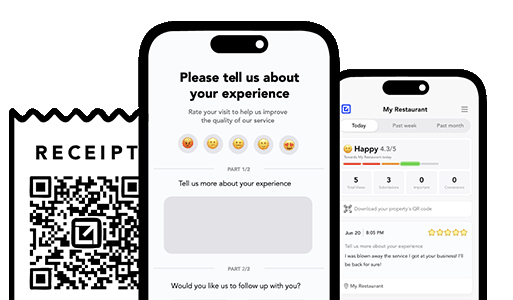
Text or email clients after every job. Catch issues early, recover unhappy clients fast, and drive repeat work with smart reminders.

Austin Spaeth is the founder of VisibleFeedback, a tool that helps service companies automate post-job follow-ups, catch issues early, and drive repeat work with smart reminders. With a background in software development and a focus on practical customer retention systems, Austin built VisibleFeedback to make it easy to text or email customers after every job, route problems to the right person, and keep relationships strong without awkward outreach. When he’s not building new features or writing playbooks for service businesses, he’s wrangling his six kids or sneaking in a beach day.
Whether you’re dealing with callbacks, unhappy customers, or low repeat work, we’ll help you tighten the follow up loop.
No credit card required.
