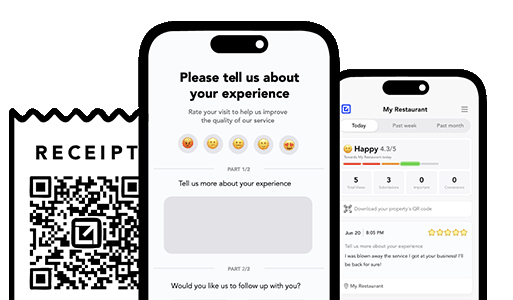
TLDR: Most service businesses lose repeat work and collect bad reviews for one simple reason: they don’t have a follow-up system they can run consistently. The fix isn’t “better marketing,” it’s better templates—short messages that customers will actually read and respond to. This library gives you ready-to-use SMS and email follow-up scripts for common scenarios: emergency jobs, routine appointments, installs, recurring services, late techs, reschedules, issue recovery, review requests, referrals, and maintenance plan upsells. You’ll also get a simple rule for using them safely: always ask for a satisfaction signal first (one-tap), route unhappy customers into private resolution, and only then ask happy customers for a public review. Use this page as a living template library you can expand over time. And if you want these templates delivered at the right time with branching logic and alerts, VisibleFeedback automates the entire follow-up loop.
How to Use This Template Library (So It Works and Doesn’t Backfire)
If you do follow-ups wrong, you create the exact thing you’re trying to avoid: complaints and bad reviews.
Use this simple safety rule:
1) Ask for a satisfaction signal first (one-tap: 🙂 😐 🙁 or Yes/No)
2) Route unhappy customers privately (get the details + respond fast)
3) Only ask happy customers for public reviews (Google/Yelp/Facebook)
This prevents the “review request → 1-star” pipeline.
Also: don’t spam. For most businesses, a clean baseline is:
- Email summary/receipt: immediately after the job (useful info)
- SMS satisfaction check: same day (emergency), next day (routine), 3 days (install)
Quick Timing Cheat Sheet
- Emergency repair: 1–3 hours after completion (SMS functional check)
- Routine service: next day late morning to early afternoon (SMS one-tap)
- Install: 2–4 days after completion (SMS one-tap)
- Recurring service: next day after every visit (SMS one-tap)
- Email: same day receipt + work summary, optional next-day “what to expect”
SMS Templates (Copy/Paste)
1) SMS: Routine Service Satisfaction Check (Next Day)
Hey [Name] — quick 2-second check: how did we do yesterday?
🙂 Great 😐 Okay 🙁 Not good
When to use: pest control visits, tune-ups, standard repairs, routine appointments.
2) SMS: Emergency Job Functional Check (Same Day)
Hey [Name] — quick check: is everything working normally now?
Yes / No
When to use: no-heat/no-cool HVAC, urgent plumbing, “get here now” situations.
3) SMS: Install Check-In (3 Days After)
Hey [Name] — checking in on the new install. How’s everything going so far?
🙂 Great 😐 Okay 🙁 Not good
When to use: HVAC installs, equipment replacement, major upgrades.
4) SMS: Recurring Service Check (After Each Visit)
Thanks for having us today, [Name]. Quick check: all good?
Yes / No
When to use: maintenance plans, ongoing pest control, weekly/monthly services.
5) SMS: Neutral Response Branch (Private Improvement Prompt)
Thanks for the honest rating. What could we improve? (Tap one)
Scheduling / Communication / Cleanliness / Price / Didn’t solve issue / Other
Goal: capture issues without turning it into a public complaint.
6) SMS: Negative Response Branch (Private Recovery + Promise of Action)
Thanks for telling us — we want to fix this. What went wrong? (Tap one)
Scheduling / Communication / Cleanliness / Price / Didn’t solve issue / Other
We’ll follow up shortly.
Rule: if someone taps negative, respond fast. Slow responses become reviews.
7) SMS: “Tech Is Running Late” Update
Hey [Name] — quick update: we’re running about [X] minutes behind. Sorry for the delay.
Do you still want us to arrive today, or would you prefer to reschedule?
Reply: TODAY or RESCHEDULE
Why it works: customers hate uncertainty more than delays.
8) SMS: Reschedule Confirmation
Thanks, [Name]. You’re confirmed for [Day] at [Time Window].
If anything changes, reply here and we’ll help.
9) SMS: Issue Resolved Confirmation (After You Fix a Complaint)
Quick check, [Name] — did we get this resolved for you?
Yes / No
Why it matters: closing the loop reduces “they never fixed it” reviews.
10) SMS: Review Request (Only After a Positive Signal)
Love to hear it. If you have 30 seconds, would you mind leaving a quick Google review?
[Review Link]
Important: never send this to neutral/negative responders.
11) SMS: Referral Prompt (For Happy Customers)
Appreciate you, [Name]. If you have a friend or neighbor who needs help, feel free to share our info.
We’ll take great care of them.
12) SMS: Maintenance Plan Soft Upsell (After a Positive Signal)
Glad it went well. Want us to set you up with our seasonal maintenance plan so you don’t have to think about it?
Reply YES and we’ll send options.
Email Templates (Copy/Paste)
Email #1: Service Summary + Receipt (Send Same Day)
Subject: Your service summary from [Business]Hi [Name],
Thanks for choosing [Business]. Here’s a quick summary of today’s visit:
What we did: - [Bullet 1] - [Bullet 2] - [Bullet 3] What to expect next: - [Expectation 1] - [Expectation 2] Need anything? Reply to this email or call/text us at [Phone]. We’re happy to help.Thanks,
[Signature]
Email #2: Install “What to Expect” (Send Next Day)
Subject: Your new install: quick tips + what to expectHi [Name],
Just a quick follow-up with a few tips to help everything go smoothly:
In the first 48 hours, you might notice: - [Normal behavior 1] - [Normal behavior 2] Call us if you notice: - [Red flag 1] - [Red flag 2] Helpful tip: - [Thermostat / filter / usage tip]If you have any questions, reply here — we’ll take care of it.
Thanks,
[Signature]
Email #3: Maintenance Plan Offer (Send 7–14 Days After a Positive Outcome)
Subject: Want us to keep this running smoothly year-round?Hi [Name],
Now that everything’s working well, most customers choose one of these options to keep problems from popping up later:
Option A: Seasonal maintenance - [Benefit] - [Benefit] Option B: Priority plan - [Benefit] - [Benefit]If you want, just reply with PLAN and we’ll send pricing and availability.
Thanks,
[Signature]
Email #4: “We Made It Right” Confirmation (After a Recovery)
Subject: Checking in — did we fix everything?Hi [Name],
I wanted to follow up after our last conversation and make sure everything is resolved.
Are we all set now? If anything still feels off, reply here and we’ll take care of it quickly.Thanks,
[Signature]
What to Avoid (These Templates Create Bad Reviews)
- Asking for a review immediately after payment
- Sending a review link to every customer (including unhappy ones)
- Long surveys that only angry people complete
- Multiple follow-ups in a short window that feel spammy
- No response process for negative feedback
How to Expand This Library Over Time
Treat this like code: add templates as you encounter real scenarios.
Add categories like:
- “Customer says price was higher than expected”
- “Customer says tech was rude”
- “Customer says problem came back”
- “Customer didn’t respond to follow-up”
- “Commercial account vs residential account”
Every repeated scenario gets a template. That’s how you become consistent.
How VisibleFeedback Helps You Use These Templates Automatically
Copy/paste works, but it breaks the moment your team gets busy.
VisibleFeedback is built to run this follow-up system without duct tape:
- sends the right template at the right time (emergency vs routine vs install)
- captures one-tap feedback (higher response)
- routes unhappy customers into private resolution with instant alerts
- routes happy customers into review prompts safely
- organizes feedback into trends so you fix the root causes
If you want higher retention and better reviews, templates are step one. A system that runs them consistently is step two.