8/7/2025
Reviews
Smart Ways to Get More Reviews [Guide]
Practical, proven ways for any business to get more authentic reviews.

Your tech finishes a job. The customer signs off. An automated message fires: “Leave us a review on Google!”
Sounds fine. Until you realize the customer had a problem they never mentioned. Maybe the tech tracked mud through the house. Maybe the repair did not hold. Maybe the price was higher than expected. They were not going to bring it up. They were just going to quietly find another company next time.
But your review tool did not know that. It pushed them toward Google anyway. And now instead of a private conversation you could have resolved in five minutes, you have a 2-star review that will sit on your profile for years.
This is not a hypothetical. It happens every week at service companies that rely on review generation tools without any mechanism to hear from unhappy customers first. (For a real-world example, see what homeowners actually Google after a plumber leaves — the worries start within hours.)
And it is the reason a growing number of service businesses are rethinking how they handle post-job communication entirely.
Review tools do one thing well: they increase the volume of online reviews. After a job is completed, they automatically send the customer a link to leave a review on Google, Facebook, Yelp, or wherever you want to build your presence.
The better ones include a “review funnel” — a filter that detects when a customer might leave a negative review and diverts them away from public sites. This sounds smart, and it is better than nothing. But there is a fundamental problem with this approach.
The funnel happens at the wrong time.
By the time a customer is being asked to leave a review, the experience is over. If something went wrong, the customer has already formed their opinion. Diverting them away from Google does not fix the problem. It just prevents the public posting. The customer is still unhappy. They are still going to leave. You just will not know why.
Review tools are designed to maximize review volume. That is their metric, their selling point, and their reason for existing. And for a business whose only goal is getting more 5-star reviews, that model works.
But if your goal is keeping customers — actually retaining them, bringing them back for repeat work, and catching problems before they become cancellations — review volume is the wrong metric to optimize for.
A feedback-first system flips the order of operations. Instead of asking “leave us a review,” it asks “how did the job go?”
That single change in sequencing creates three outcomes that review tools cannot replicate.
When you ask a customer for feedback before pushing them toward a public review site, unhappy customers tell you what went wrong. Privately. In your inbox.
A plumber’s customer whose water heater install left a mess in the garage? They will tell you in a feedback message. They probably would not have called your office. But they would have left a 3-star review or — more likely — just never called you again.
Private feedback gives you the chance to fix the problem, save the relationship, and prevent the bad review entirely. Review tools skip this step. They go straight to the public ask.
When a customer gives positive feedback, that is the natural opening to ask for a public review. The customer just told you they are happy. They are in the right frame of mind. The ask feels organic, not transactional.
This approach typically generates fewer total reviews than a blast-everyone strategy. But the reviews it generates are overwhelmingly positive, because you have already filtered out the customers who had problems. Your review profile improves not by volume alone, but by quality.
Feedback creates data. When every customer hears from you after every job, you start to see patterns. Which technicians consistently get positive feedback? Which service types generate complaints? Which customers are at risk of leaving?
Review tools give you a count of reviews. Feedback systems give you a map of your customer relationships.
Let’s put numbers on this.
A mid-size pest control company with 400 quarterly customers and a 25% annual churn rate loses 100 customers per year. At $400 per customer per year, that is $40,000 in lost revenue.
Now consider that many of those lost customers left because of a problem nobody asked about. The tech left the gate open. There was still pest activity after the treatment. The invoice was higher than the estimate. These are fixable problems — but only if you know about them.
If a feedback-first system catches even 10% of those problems and saves those relationships, that is 10 customers saved, $4,000 recovered in year one, and $12,000 over three years when you account for the repeat revenue those customers would have generated.
The same math applies to HVAC companies, plumbing businesses, cleaning services, and every other trade where repeat customers are the backbone of revenue.
Review tools are not bad products. They make sense in specific situations.
If you are a new business with fewer than 20 reviews on Google, review volume is your most urgent need. Customers trust businesses with more reviews, and getting from 8 reviews to 50 reviews will move the needle on new customer acquisition. A review tool optimized for volume can help you get there faster.
If your business is primarily one-time transactions — you rarely see the same customer twice — the feedback loop matters less. You are not trying to retain customers for repeat work. You just need reviews for social proof.
But if you run a service business where repeat customers drive your revenue — quarterly pest control, seasonal HVAC, recurring cleaning, ongoing plumbing relationships — review volume alone is not enough. You need the feedback step first.
If you are evaluating alternatives to your current review tool, here is what matters.
The tool should contact your customer within 24 hours of every job and ask how it went. Not “leave us a review.” Just “how was the experience?” This is the step that catches problems.
When customers respond, you need somewhere for that feedback to go. Not a generic email. A structured inbox where feedback is tracked, can be assigned to a team member, and has a resolution workflow. A one-star rating sitting in a CSV file helps nobody.
Customers who give positive feedback should be routed to Google or Facebook for a public review. Customers who report a problem should be routed to your team for resolution. This is similar to a “review funnel” but it happens earlier in the process — before the customer is thinking about public reviews at all.
Follow-up is half the equation. The other half is bringing customers back. A tool that sends feedback requests AND sends reminders for upcoming maintenance, seasonal tune-ups, or annual services keeps the entire customer lifecycle in one system.
Enterprise reputation tools run $200 to $400 per month or more. For a service company doing $500K to $2M in revenue, that is hard to justify. Look for tools purpose-built for service businesses in the $50 to $100 per month range that include both feedback and reminders without nickel-and-diming on SMS, users, or locations.
The reputation management industry was built on one premise: more reviews equals more business. And that premise is not wrong. But it is incomplete.
The service companies growing fastest right now are not the ones with the most reviews. They are the ones who know what their customers actually think, who catch problems before they escalate, and who stay in touch between jobs so the customer never has a reason to look elsewhere.
Review tools solve the visibility problem. Feedback-first systems solve the retention problem. And for most service businesses, retention is where the real money is.
A customer who comes back four times a year for ten years is worth far more than a single 5-star review. The companies that figure this out first will have an enormous advantage over the ones still optimizing for review count.
If you are evaluating your options, VisibleFeedback was built specifically for this problem. It sends automated follow-ups after every job, routes feedback to a private inbox, directs happy customers to leave reviews, and sends reminders that bring customers back for repeat work. Standard plan starts at $65/month and includes everything described above. No contracts, cancel anytime.
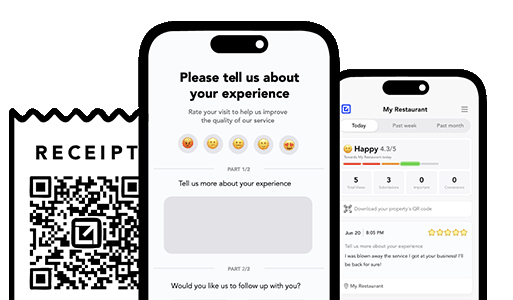
Text or email clients after every job. Catch issues early, recover unhappy clients fast, and drive repeat work with smart reminders.

Austin Spaeth is the founder of VisibleFeedback, a tool that helps service companies automate post-job follow-ups, catch issues early, and drive repeat work with smart reminders. With a background in software development and a focus on practical customer retention systems, Austin built VisibleFeedback to make it easy to text or email customers after every job, route problems to the right person, and keep relationships strong without awkward outreach. When he’s not building new features or writing playbooks for service businesses, he’s wrangling his six kids or sneaking in a beach day.
Whether you’re dealing with callbacks, unhappy customers, or low repeat work, we’ll help you tighten the follow up loop.
No credit card required.
