🚀 Start Here For Help

Whether you’re dealing with callbacks, unhappy customers, or low repeat work, we’ll help you tighten the follow up loop.

Turn Jobs Into Repeat Work

VisibleFeedback automatically texts or emails customers after every job.

  • Automated texts or emails post job
  • Catch issues before they go public
  • Reminders that drive repeat jobs
Send My First Follow Up
14 day trial, no credit card required

Recent Retention Insights

2/14/2026
Retention

Cleaning Company Customer Retention: How to Keep One-Time Clients Coming Back

One-time cleaning customers are revenue that walks away. Learn how cleaning companies turn occasional clients into recurring monthly business.

2/5/2026
Retention

How to Keep Customers When Your Costs Are Rising

Material costs are climbing, and service businesses are raising prices. Here's how to keep your customers from walking when the bill goes up.

2/4/2026
Reviews

VisibleFeedback vs. NiceJob: Which One Actually Protects Your Business?

NiceJob gets you more reviews. VisibleFeedback keeps more customers. Here's an honest, side-by-side comparison of pricing, features, and what each tool actually does for your service business.

2/4/2026
Electrician

Why Electricians Get Zero Reviews (and How to Fix It in 90 Days)

Electricians average 70% fewer Google reviews than plumbers or HVAC pros. The work is invisible — but your reputation doesn't have to be.

2/4/2026
Reviews

Why Service Companies Are Switching from Review Tools to Feedback-First Systems

Review tools push every customer toward Google reviews. Feedback-first systems catch problems before they go public. Here's why service companies are making the switch.

2/3/2026
Cleaning

The $3,900 Client: Why Cleaning Companies Lose Recurring Revenue (and the Fix)

One recurring cleaning client is worth $3,900/year. Most slip away after the first job. Here's the 4-step follow-up loop that locks them in.

2/3/2026
Pest Control

Why Pest Control Companies Lose Customers Between Treatments (And How to Fix It)

Pest control companies lose customers between quarterly treatments because of silence, not bad service. Here are 5 practical fixes to keep pest control customers coming back.

2/2/2026
HVAC

How Smart HVAC Companies Use Automated Reminders to Drive Repeat Revenue

HVAC companies leave thousands on the table by not reminding past customers to come back. Here are the four reminders every HVAC company should automate.

2/1/2026
Pest Control

Why Pest Control Customers Cancel (And 5 Ways to Stop It)

Pest control companies lose customers for five fixable reasons. Here's what drives them away and how to keep them coming back.

1/31/2026
HVAC

HVAC Customer Retention: How to Turn One-Time Repairs Into Year-Round Revenue

HVAC companies lose thousands in repeat work every year. Learn how maintenance agreements, follow-ups, and service reminders turn one-time calls into loyal customers.

1/31/2026
Retention

The Post-Service Follow-Up Most Service Businesses Skip (And Why It Costs Them Thousands)

Most service businesses finish a job and move on. A simple post-service follow-up can catch problems early, earn reviews, and turn one-time jobs into repeat customers.

1/29/2026
Landscaping

Why Your Landscaping Clients Ghost After One Season (And the Retention Loop That Keeps Them)

Most landscaping clients don't leave because they're unhappy. They leave because no one gave them a reason to stay. Here's the retention loop that fixes seasonal churn.

1/28/2026
Tips

The Reminder Revenue Playbook: How Service Businesses Turn One-Time Jobs Into Recurring Revenue

Every completed service job is a future revenue opportunity — if you remind the customer at the right time. This is the playbook for turning one-time work into recurring revenue through smart, automated reminders.

1/28/2026
Tips

The Feedback Loop: How Smart Service Businesses Turn Customer Opinions Into Revenue, Reviews, and Retention

Customer feedback isn't just for surveys and suggestion boxes. When captured at the right moment and routed correctly, it becomes your most powerful tool for preventing bad reviews, improving operations, driving repeat business, and growing revenue.

1/28/2026
Tips

The Complete Guide to Post-Job Follow-Ups for Service Businesses

The definitive guide to building a post-job follow-up system: why it matters, how to time it, what to say, how to handle problems, and how to turn follow-ups into reviews, retention, and revenue.

Show more insights
How to Keep Customers When Your Costs Are Rising
© Photo by Towfiqu barbhuiya on Unsplash

How to Keep Customers When Your Costs Are Rising

TLDR: Tariffs and inflation have pushed material costs up 15-35% for HVAC, plumbing, and electrical contractors. Most businesses are passing some of that on to customers, and some customers are going to shop around. The ones who leave usually aren’t leaving because of the price itself — they leave because they don’t feel the relationship is worth the premium. This article covers five practical strategies for keeping customers during price increases: communicating early and honestly about cost changes, adding value without adding cost, following up after every job to build loyalty, using automated reminders to stay top of mind, and focusing on the customers who already trust you rather than chasing new ones. Retention is always cheaper than acquisition — but during a cost crunch, it’s the difference between surviving and thriving.


How to Keep Customers When Your Costs Are Rising

Your supplier just bumped prices again. Copper is up 38% from last year. The HVAC unit that cost you $2,800 six months ago now costs $3,400. And somewhere between the invoice and the customer’s kitchen table, you know what they’re thinking: “Is it time to call someone cheaper?”

This is the reality for HVAC, plumbing, and electrical contractors right now. Tariffs and inflation have pushed material costs up 15-35%, and most service businesses have no choice but to pass at least some of that on. The question isn’t whether to raise prices. The question is how to do it without losing the customers you’ve worked hard to earn.

Why Customers Leave When Prices Go Up (It’s Not the Money)

Here’s the thing most business owners get wrong: customers don’t leave because your price went up by $50 or $100. They leave because they don’t feel enough loyalty to absorb the increase.

Think about it. You probably pay more for your favorite restaurant than the one next door. You stick with your barber even though there’s a cheaper option down the street. The price isn’t the issue. The relationship is.

When a customer gets a higher-than-expected bill and hasn’t heard from you since the last job six months ago, the price feels like a surprise from a stranger. But when they’ve gotten a follow-up after the last job, a reminder that their filter is due, and a quick check-in when the season changed — that same price increase feels like fair business from someone they trust.

A study from Bain & Company found that increasing customer retention by just 5% can boost profits by 25-95%. When your costs go up, the math gets even more dramatic. Replacing a lost customer costs five to twenty times more than keeping an existing one. You can’t afford the churn.

Strategy 1: Communicate Early and Honestly About Price Changes

The worst way to deliver a price increase is on the invoice after the work is done. No warning, no explanation, just a number that’s higher than last time.

Instead, get ahead of it. If your costs have gone up and your prices need to follow, tell your customers before the next job.

This doesn’t have to be complicated. A simple email or text works:

“Hey [Name], wanted to give you a heads-up before your spring tune-up. Material costs have gone up significantly this year due to supply chain changes, and we’ve had to adjust our pricing slightly. We’re still committed to giving you the best service, and we wanted you to hear it from us first rather than be surprised on the invoice.”

That’s it. No long apology. No essay about tariffs. Just a direct, honest heads-up from someone who respects their time.

Businesses that communicate proactively about price changes see 34% better customer retention than those who stay silent and hope nobody notices. People can handle bad news. What they can’t handle is feeling blindsided.

VisibleFeedback Icon

Automate follow ups after every job

Catch issues early and drive repeat work with smart reminders.

Start A Free Trial

Strategy 2: Add Value Without Adding Cost

When your price goes up, the customer is mentally recalculating whether you’re worth it. You need to tip that scale.

The cheapest way to add value is through communication. Things that cost you almost nothing but make the customer feel taken care of:

  • A quick text after the job: “Everything went smooth today. If you notice anything off in the next few days, just call us.”
  • A seasonal tip: “Winter’s coming. Here’s one thing you can do to avoid a frozen pipe this year.”
  • A reminder before their next service is due: “Your AC hasn’t been serviced in 11 months. Want us to get you on the schedule before the summer rush?”

None of these cost you a dime. But they build the kind of relationship that makes a $75 price increase feel reasonable instead of outrageous.

Some contractors are also bundling small extras into their service calls without raising the price further — a free drain check during a plumbing visit, a thermostat calibration during an HVAC tune-up. These tiny additions cost minutes but buy enormous goodwill.

Strategy 3: Follow Up After Every Single Job

This is the most important thing on this list, and it’s the one most service businesses skip.

After the job is done, follow up. Every time. Not just the big installs. Not just the new customers. Every job.

Why? Because the follow-up is your early warning system. If the customer isn’t happy — even slightly — you want to know now, not when they leave a two-star review next month. When costs are higher, customers are pickier. A $300 repair job that would have gotten a pass at $250 now gets scrutinized. If there’s even a minor issue, that customer is already one foot out the door.

A post-job follow-up catches that. “How’d everything go? Anything we missed?” gives the customer a private channel to voice concerns before they go public. It also signals that you care about the work after you’ve been paid, which is rare in this industry and builds real loyalty.

The businesses that follow up consistently report fewer callbacks, fewer bad reviews, and significantly higher repeat rates. When your margins are tight, callbacks are devastating. A single prevented callback can save you $150-$300 in labor and materials.

Strategy 4: Stay Top of Mind with Automated Reminders

Here’s a number that should make every service business owner uncomfortable: 68% of customers leave because they feel the business doesn’t care about them. Not because of price. Not because of bad work. Because of indifference.

The easiest fix is automated reminders. Set them up once and let them run.

  • Quarterly pest control treatments? Remind them two weeks before.
  • Annual HVAC tune-ups? Send a reminder when the season changes.
  • Filter replacements? Ping them when it’s time.
  • Plumbing inspections? A yearly check-in builds the habit.

These reminders do two things. First, they generate repeat revenue without you lifting a finger. Second, they keep you in the customer’s mind as their go-to service provider. When the competitor down the street sends a flyer, your customer already has a relationship with you. That flyer goes in the trash.

During a period of rising costs, this matters more than ever. The customer who hears from you regularly is far less likely to price-shop than the one who forgot your company’s name.

Strategy 5: Double Down on Your Existing Customers

When costs go up and margins get tight, the natural instinct is to chase new customers to make up the revenue. That instinct is wrong.

Acquiring a new customer costs five to twenty times more than keeping an existing one. And existing customers spend 67% more on average than new ones. The math is clear: your current customers are your most valuable asset, especially right now.

Instead of pouring money into new customer acquisition, invest that energy into your existing base:

  • Reach out to past customers who haven’t booked in a while.
  • Offer a loyalty discount or a maintenance plan that locks in a fair price.
  • Ask your best customers for referrals. A referred customer costs you nothing to acquire and converts at a much higher rate.
  • Check in with customers who had big jobs done recently. “How’s that new water heater working out?” goes a long way.

Businesses with 4+ star ratings generate 32% more revenue than those with lower scores. Your existing happy customers are the ones writing those reviews and sending those referrals. Protect that base.

The Bottom Line

Rising costs are stressful. Nobody wants to raise prices. But the businesses that survive this period won’t be the ones with the lowest prices — they’ll be the ones with the strongest customer relationships.

Communicate honestly. Follow up consistently. Stay in touch between jobs. Make your existing customers feel valued.

The contractor who does these things keeps their customers through a $75 price increase. The contractor who doesn’t loses them to a $10 flyer from the competition.

Key Takeaways

  • Customers don’t leave over price alone — they leave when the relationship doesn’t justify the price
  • Proactive communication about price changes improves retention by 34%
  • Post-job follow-ups catch problems early and prevent costly callbacks
  • Automated reminders keep you top of mind and drive repeat revenue without extra effort
  • Existing customers are 5-20x cheaper to retain than new ones are to acquire

Rising costs make every customer relationship more valuable. VisibleFeedback automates post-job follow-ups and repeat-service reminders so your customers hear from you consistently — without adding work to your plate. When your prices go up, your relationships keep your customers from going anywhere.
VisibleFeedback running on iphones

Turn Jobs Into Repeat Work

Text or email clients after every job. Catch issues early, recover unhappy clients fast, and drive repeat work with smart reminders.

No card needed, cancel any time

Related articles

Cleaning Company Customer Retention: How to Keep One-Time Clients Coming Back

2/14/2026

One-time cleaning customers are revenue that walks away. Learn how cleaning companies turn occasional clients into recurring monthly business.

VisibleFeedback vs. NiceJob: Which One Actually Protects Your Business?

2/4/2026

NiceJob gets you more reviews. VisibleFeedback keeps more customers. Here's an honest, side-by-side comparison of pricing, features, and what each tool actually does for your service business.

Why Electricians Get Zero Reviews (and How to Fix It in 90 Days)

2/4/2026

Electricians average 70% fewer Google reviews than plumbers or HVAC pros. The work is invisible — but your reputation doesn't have to be.

People also ask

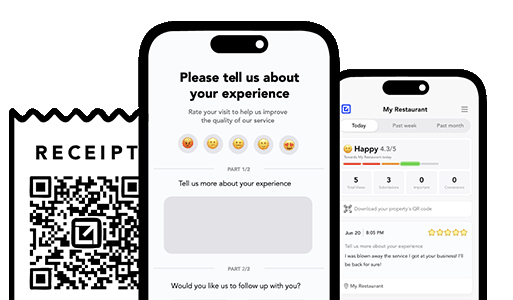
How can I prevent negative reviews from hurting my business? You can’t stop every unhappy customer from sharing feedback, but you can intercept it before it goes public. Tools like VisibleFeedback allow customers to scan a QR code and leave feedback privately. If the feedback is negative, you’re alerted instantly so you can resolve the issue before it turns into a 1-star review.
Why are customer reviews so important for local SEO? Reviews are one of the top local ranking factors on Google. Businesses with consistent positive reviews rank higher in search results and attract more customers. By using VisibleFeedback to capture happy customer moments and guide them to Google or Yelp, you build a steady flow of authentic reviews that improve both your reputation and your local SEO.
What’s the best way to collect customer feedback in 2025? Traditional methods like comment cards and long surveys don’t work anymore, customers want convenience. The easiest way to collect real-time feedback in 2025 is by using QR codes and mobile-friendly forms. VisibleFeedback makes this simple, helping you get instant insights while turning satisfied customers into 5-star reviewers.
How does feedback help improve retention? Feedback reveals what keeps customers loyal and what drives them away. VisibleFeedback helps you act on insights before customers churn.
What’s the link between customer experience and retention? Positive experiences lead to repeat business. Using tools like VisibleFeedback ensures you consistently deliver great experiences by resolving issues early.
Why should businesses prioritize retention over acquisition? Retaining customers is cheaper and more profitable than finding new ones. VisibleFeedback helps strengthen retention by keeping customers satisfied.
Authored by Austin Spaeth

Austin Spaeth

Austin Spaeth is the founder of VisibleFeedback, a tool that helps service companies automate post-job follow-ups, catch issues early, and drive repeat work with smart reminders. With a background in software development and a focus on practical customer retention systems, Austin built VisibleFeedback to make it easy to text or email customers after every job, route problems to the right person, and keep relationships strong without awkward outreach. When he’s not building new features or writing playbooks for service businesses, he’s wrangling his six kids or sneaking in a beach day.

🚀 What's your goal? Get a plan ...

🚀 Start Here For Help

Whether you’re dealing with callbacks, unhappy customers, or low repeat work, we’ll help you tighten the follow up loop.

×

👋 Wait! Before You Go

Send your first follow up today! Catch issues early and drive repeat work.

No credit card required.