🚀 Start Here For Help

Whether you’re dealing with callbacks, unhappy customers, or low repeat work, we’ll help you tighten the follow up loop.

Turn Jobs Into Repeat Work

VisibleFeedback automatically texts or emails customers after every job.

  • Automated texts or emails post job
  • Catch issues before they go public
  • Reminders that drive repeat jobs
Send My First Follow Up
14 day trial, no credit card required

Recent Tips Insights

1/10/2026
Tips

How Service Companies Get More Reviews (Without Being Pushy or Shady)

Most happy customers don’t leave reviews because they forget. Here’s a compliant, repeatable system: when to ask, what to say, and how to increase review volume without review gating.

1/10/2026
Tips

How to Reduce Callbacks: A Post-Job Follow-Up System for Service Companies

Callbacks usually come from small issues that weren’t caught early. Here’s a simple post-job follow-up workflow (templates, escalation rules, and tracking) you can implement today.

1/10/2026
HVAC

How HVAC Companies Reduce Callbacks With a 2-Message Follow-Up

Two short messages catch most HVAC issues early: a same-day functional check and a day-two confirmation after the system has had time to run.

1/10/2026
HVAC

HVAC Maintenance Reminders: Campaigns That Book More Tune-Ups

A practical reminder playbook for HVAC companies: 30/60/90 cadences tied to filters, seasonal checkups, and memberships—without sounding spammy.

1/10/2026
Tips

Turn One-Time Customers Into Repeat Work (Without Spam)

Repeat work doesn’t happen by accident—customers forget. Here’s a simple reminder system (with templates and trade-specific examples) that gets rebooks and referrals without feeling spammy.

1/10/2026
Tips

What to Measure: The 5 Metrics That Actually Matter (Callbacks, Response Time, Repeat Jobs)

Stop tracking vanity numbers. These five metrics tell you if you’re saving customers, protecting reviews, and turning one-time jobs into repeat work.

8/12/2025
Salon

Slow Day Tips for Salons

Creative and profitable ways salons can make the most of a slow day.

8/5/2025
Tips

5 Smart Things to Do on a Slow Day That Will Actually Grow Your Business

Even your slowest days are full of opportunity. Here’s how to use them to grow smarter, strengthen your brand, and get ahead of your competitors.

7/30/2025
Retail

Fix a Slow Retail Wednesday Fast - Foot Traffic Tips That Convert

Turn a slow midweek slump into foot traffic and momentum with smart tactics.

7/24/2025
Marketing

Local SEO Tactics for 2025: How Small Businesses Can Dominate Local Search

Master local SEO tactics in 2025 to boost visibility, rankings, and revenue.

7/23/2025
Marketing

Local SEO Tactics That Actually Work in 2025

The ultimate 2025 guide to local SEO tactics that boost rankings, traffic, and trust.

7/17/2025
Reviews

Why Customers Leave Bad Feedback (And How to Stop It)

Learn why negative feedback spreads faster than good, and how to prevent it.

7/13/2025
Reviews

Part 1: Customers Are Talking... Not to You

Most feedback never reaches you, and it’s costing your business more than you think.

7/13/2025
Reviews

Part 2: 5 Clever Ways to Get Honest Feedback

Get valuable feedback from customers, without increasing your risk of bad reviews.

7/13/2025
Reviews

Part 3: The VisibleFeedback Advantage

Use VisibleFeedback to stop bad reviews, boost 5-stars, and grow your business.

Show more insights
What to Measure: The 5 Metrics That Actually Matter (Callbacks, Response Time, Repeat Jobs)
© Photo by William Warby on Unsplash

What to Measure: The 5 Metrics That Actually Matter (Callbacks, Response Time, Repeat Jobs)

TLDR: Most small service businesses track the wrong stuff because it’s easy: leads, calls, website traffic, maybe star rating. Those numbers don’t tell you why customers churn, why reviews go bad, or where profits leak. The metrics that actually matter are operational and customer-facing: callbacks (redo work), response time to unhappy customers, resolution time, repeat job rate, and review conversion rate. These mirror real business outcomes: fewer wasted trips, fewer public complaints, higher retention, and more revenue per customer. This article lays out five simple metrics you can track in a spreadsheet or dashboard, how to calculate each, what “good” looks like, and how to improve them. It also shows how VisibleFeedback naturally supports these metrics by capturing one-tap satisfaction signals, triggering fast recovery workflows, and turning happy customers into reviews and repeat work.


Why Most Metrics Are Useless

Traffic, impressions, followers, even raw lead count — those are inputs. Inputs are noisy. They make you feel productive, but they don’t tell you if the business is getting healthier.

If you want a dashboard that actually changes how you run the company, it should answer five blunt questions:

  • Are we doing work twice?
  • Are we reacting fast enough when someone is unhappy?
  • Are we actually fixing problems, or just “touching” them?
  • Are customers coming back?
  • Are satisfied customers leaving reviews?

That’s it. Everything else is secondary.


1) Callback Rate (Redo Work)

Callbacks are the silent killer. They destroy margin and schedule capacity.

Definition: Percent of jobs that require an additional visit to correct something you should’ve done right the first time.

Formula:

  • Callback rate = callbacks / total jobs

Track it two ways:

  • 7-day callbacks (immediate quality issues)
  • 30-day callbacks (delayed failures, install issues)

What “good” looks like:

  • Varies by trade, but you want it low and trending down. The real target is consistent improvement, not a perfect number.

How to improve it:

  • Categorize callbacks (didn’t fix issue, workmanship, parts, communication)
  • Identify tech patterns (repeat offenders)
  • Fix the top one root cause each month
  • Add a simple “completion checklist” for the most common job type

Where VisibleFeedback helps:

  • Negative follow-up responses often predict callbacks. Catching those early prevents repeat trips and angry reviews.

2) Response Time to Unhappy Customers

This is the difference between private recovery and public review.

Definition: Time from negative feedback received to first real contact (call/SMS) from your team.

Formula:

  • Avg response time = average(first_contact_time - negative_feedback_time)
  • Also track median, because outliers lie.

What “good” looks like:

  • Same-day, ideally within an hour during business hours.
  • The main goal: don’t let negatives sit overnight without acknowledgment.

How to improve it:

  • Route all negative feedback to a single owner (dispatcher/manager)
  • Create an “acknowledge immediately” script
  • Set a simple internal SLA (example: “negative feedback gets contacted within 60 minutes”)

Where VisibleFeedback helps:

  • One-tap feedback capture + instant alerts makes response time measurable and enforceable.

3) Resolution Time (How Long Issues Stay Open)

Response time is the first 5%. Resolution time is the real work.

Definition: Time from issue created to issue marked resolved (and ideally confirmed).

Formula:

  • Avg resolution time = average(resolved_time - issue_open_time)

Important detail:

  • “Resolved” shouldn’t mean “we sent a message.” It should mean “we fixed it and confirmed.”

What “good” looks like:

  • Depends on your work type, but shorter is almost always better. Long-open issues generate repeat complaints, refunds, and bad reviews.

How to improve it:

  • Use a strict status flow (New → Acknowledged → Contacted → Resolved)
  • Require a next action + due date on every open issue
  • Run a 10-minute daily review of open issues

Where VisibleFeedback helps:

  • Structured issue statuses and timelines make it hard for problems to “disappear.”

4) Repeat Job Rate (The Real Retention Metric)

Repeat jobs are the most honest growth metric because they reflect trust.

Definition: Percent of customers who book again within a defined window.

Pick a window that matches your business:

  • 90 days for urgent/reactive services
  • 6–12 months for seasonal maintenance trades
  • quarterly for recurring services

Formula:

  • Repeat job rate = customers with 2+ jobs in window / total customers in cohort

What “good” looks like:

  • You’re trending upward and you can explain why. If you can’t explain it, you’re not controlling it.

How to improve it:

  • Add helpful reminder cadences (seasonal, maintenance intervals)
  • Follow up after one-time jobs with “preventive next step” options
  • Close the loop on neutral/negative experiences before asking for repeat work

Where VisibleFeedback helps:

  • You can segment reminders based on satisfaction signals so you’re not pitching unhappy customers.

5) Review Conversion Rate (From “Happy” to Public Proof)

Star rating is an outcome. Review conversion rate is a controllable process metric.

Definition: Percent of satisfied customers who leave a public review after being asked.

Formula:

  • Review conversion rate = reviews received / review requests sent
  • Better: reviews received / “positive feedback” customers

What “good” looks like:

  • Higher than your baseline and improving. Many businesses are shocked at how low this is until they measure it.

How to improve it:

  • Ask consistently, not randomly
  • Make it one-click (direct link)
  • Don’t ask too soon (avoid price pain / irritation)
  • Don’t spam; one clean request is enough
  • Avoid shady gating tactics; focus on timing and service recovery

Where VisibleFeedback helps:

  • It naturally separates “ask for feedback” from “ask for review,” and gives you a clean way to time review invites.

The Simple Dashboard (What to Put on One Screen)

If you want this to be usable, keep it to one page with five tiles:

  • Callback rate (7-day, 30-day)
  • Response time to negative feedback (avg + median)
  • Resolution time (avg + open issue count)
  • Repeat job rate (by cohort/window)
  • Review conversion rate (requests → reviews)

Optional but useful:

  • Number of open issues by status (New/Acknowledged/Contacted)
  • Top 3 complaint categories this month

How to Start Tracking This Without Overengineering

If you don’t track these today, don’t build a fancy system. Start with a sheet.

Minimum fields you need:

  • Job ID / customer
  • Job date
  • Follow-up response (happy/neutral/unhappy)
  • Negative feedback time
  • First contact time
  • Resolved time
  • Callback? (Y/N)
  • Repeat booking? (Y/N within window)
  • Review requested? (Y/N)
  • Review received? (Y/N)

This is enough to calculate all five metrics.


Why These Metrics Mirror VisibleFeedback’s Value

VisibleFeedback is built around the exact leak points these metrics expose:

  • One-tap satisfaction signals → reduces blind spots
  • Fast alerts + recovery workflow → improves response and resolution time
  • Structured categories → reduces callbacks through root-cause fixes
  • Safer review asks → improves review conversion
  • Smarter reminders based on sentiment → improves repeat job rate

Even if you don’t use any software, these are still the right numbers to run the business.


Bottom Line

If you track only five things, track the things that directly connect to customer experience and wasted labor:

1) Callback rate
2) Response time to unhappy customers
3) Resolution time
4) Repeat job rate
5) Review conversion rate

If those improve, everything else gets easier: reviews, referrals, revenue, and your day-to-day stress.
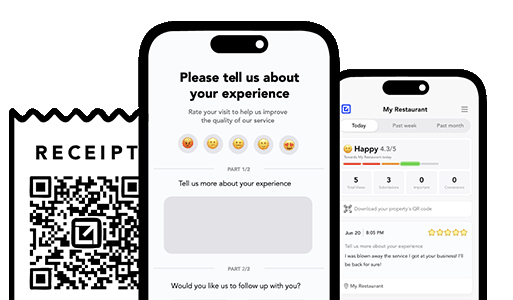
VisibleFeedback running on iphones

Turn Jobs Into Repeat Work

Text or email clients after every job. Catch issues early, recover unhappy clients fast, and drive repeat work with smart reminders.

No card needed, cancel any time

Related articles

How Service Companies Get More Reviews (Without Being Pushy or Shady)

1/10/2026

Most happy customers don’t leave reviews because they forget. Here’s a compliant, repeatable system: when to ask, what to say, and how to increase review volume without review gating.

How to Reduce Callbacks: A Post-Job Follow-Up System for Service Companies

1/10/2026

Callbacks usually come from small issues that weren’t caught early. Here’s a simple post-job follow-up workflow (templates, escalation rules, and tracking) you can implement today.

How HVAC Companies Reduce Callbacks With a 2-Message Follow-Up

1/10/2026

Two short messages catch most HVAC issues early: a same-day functional check and a day-two confirmation after the system has had time to run.

People also ask

How can I prevent negative reviews from hurting my business? You can’t stop every unhappy customer from sharing feedback, but you can intercept it before it goes public. Tools like VisibleFeedback allow customers to scan a QR code and leave feedback privately. If the feedback is negative, you’re alerted instantly so you can resolve the issue before it turns into a 1-star review.
Why are customer reviews so important for local SEO? Reviews are one of the top local ranking factors on Google. Businesses with consistent positive reviews rank higher in search results and attract more customers. By using VisibleFeedback to capture happy customer moments and guide them to Google or Yelp, you build a steady flow of authentic reviews that improve both your reputation and your local SEO.
What’s the best way to collect customer feedback in 2025? Traditional methods like comment cards and long surveys don’t work anymore, customers want convenience. The easiest way to collect real-time feedback in 2025 is by using QR codes and mobile-friendly forms. VisibleFeedback makes this simple, helping you get instant insights while turning satisfied customers into 5-star reviewers.
What’s the best tip for managing your business reputation? Respond to feedback quickly and professionally. Tools like VisibleFeedback make this easy by notifying you instantly of negative experiences.
How can I encourage customers to leave reviews? Make it simple and convenient, QR codes are perfect for this. VisibleFeedback provides branded QR codes to collect reviews without friction.
What’s a quick way to improve customer experience? Listen to customers and act fast on their feedback. VisibleFeedback makes this possible with real-time alerts and easy feedback channels.
Authored by Austin Spaeth

Austin Spaeth

Austin Spaeth is the founder of VisibleFeedback, a tool that helps service companies automate post-job follow-ups, catch issues early, and drive repeat work with smart reminders. With a background in software development and a focus on practical customer retention systems, Austin built VisibleFeedback to make it easy to text or email customers after every job, route problems to the right person, and keep relationships strong without awkward outreach. When he’s not building new features or writing playbooks for service businesses, he’s wrangling his six kids or sneaking in a beach day.

🚀 What's your goal? Get a plan ...

🚀 Start Here For Help

Whether you’re dealing with callbacks, unhappy customers, or low repeat work, we’ll help you tighten the follow up loop.

×

👋 Wait! Before You Go

Send your first follow up today! Catch issues early and drive repeat work.

No credit card required.