2/2/2026
HVAC
How Smart HVAC Companies Use Automated Reminders to Drive Repeat Revenue
HVAC companies leave thousands on the table by not reminding past customers to come back. Here are the four reminders every HVAC company should automate.

TLDR: Post-job follow-up is the single highest-ROI activity a service business can implement. It costs almost nothing, prevents the majority of bad reviews, catches problems early, generates 5-star reviews, and builds trust that drives repeat business. This guide covers everything: timing, scripts, negative response handling, review requests, and scaling — for every trade.
Every service business — plumbing, electrical, HVAC, roofing, landscaping, cleaning, pest control, and beyond — faces the same problem:
The job ends. The customer goes quiet. And the next time you hear from them, it’s either a callback, a bad review, or silence (they hired someone else).
Between job completion and the next customer interaction, there’s a gap. And in that gap, customer anxiety builds, small issues grow into big problems, and negative reviews are born.
Post-job follow-up closes that gap. It’s the single simplest change a service business can make — and it impacts more metrics than any marketing campaign, software tool, or operational improvement.
This guide is the complete playbook: why it works, how to build it, and how to scale it. Use it as a reference. Implement it in phases. Come back to it when you need to refine.
After every service job, the customer enters a psychological state we call the anxiety window. During this period:
The anxiety window varies by trade:
| Trade | Anxiety window | Why |
|---|---|---|
| Plumbing | 0-48 hours | Water damage fear; immediate re-clog possibility |
| Electrical | 0-7 days | Invisible work; fire anxiety; can’t self-verify |
| HVAC | 0-24 hours | Temperature is immediately testable |
| Roofing | 0-30+ days | Weather-dependent verification; can’t see the work |
| Landscaping | 7-30 days | Biological settling; Day 1 vs. Day 14 gap |
| Cleaning | 0-4 hours | Immediately visible; very short window |
| Pest control | 3-14 days | Pests may reappear during treatment window |
The follow-up needs to arrive during the anxiety window — not after it. If you wait too long, the customer has already formed their opinion. Your message becomes irrelevant noise.
When a customer has a post-job concern, they don’t call your office. Research and behavior patterns consistently show:
At no point in this escalation does “call the company” appear as the default action. A follow-up message short-circuits the entire sequence by giving the customer a direct, easy path to express concerns privately.
We mapped this pattern in detail for plumbing in our article on what homeowners Google after your plumber leaves — the same psychology applies across every trade.
Regardless of your industry, the core follow-up system has four messages:
Message 1: Same-day check-in (1-4 hours after job completion)
Purpose: Catch immediate issues. Show the customer you care about the outcome.
Format: Short. One question. Easy response.
“Thanks for choosing [Company]. Quick check — is everything working/looking as expected? Yes / No”
Or (one-tap):
“How’s everything after today’s [service type]? 🙂 Great / 😐 Okay / 🙁 Not good”
Message 2: Next-day follow-up (18-36 hours after completion)
Purpose: Catch issues that develop after the system has been running, the product has settled, or the customer has had time to evaluate.
Format: Similar to Message 1, but acknowledges time has passed.
“Quick follow-up — still looking/working good today? Yes / No”
Message 3: Issue resolution confirmation (after any return visit or phone fix)
Purpose: Confirm that the issue is actually resolved. Don’t assume.
“Quick check — are we all set now? Everything resolved? Yes / No”
Message 4: Review request (after confirmed positive outcome only)
Purpose: Generate a 5-star review from a verified happy customer.
“Glad everything worked out! If you have a minute, an honest Google review helps other [homeowners/customers] find reliable [service type]. [Google Link]”
Critical rule: Message 4 only goes out after Messages 1 and/or 2 come back positive. Never ask for a review from a customer who hasn’t confirmed satisfaction. This is the difference between review generation and review gating — and it’s what makes the system both effective and ethical.
The 4-message system is the same for every trade. The timing changes:
| Trade | Message 1 | Message 2 | Message 4 (Review) |
|---|---|---|---|
| Plumbing | 2-3 hours | Next morning | Day 2-3 |
| Electrical | 3-4 hours | Next morning | Day 3-5 |
| HVAC | 2-3 hours | Next morning | Day 2-3 |
| Roofing | Same day | Day 3-5 + after first rain | Day 14-30 |
| Landscaping | Same day | Day 7-14 | Day 30 |
| Cleaning | 1-2 hours | N/A (usually single message) | Same day or Day 1 |
| Pest control | Same day | Day 7-10 | Day 14-21 |
The timing reflects the anxiety window for each trade. Fast-verification trades (plumbing, HVAC, cleaning) get faster follow-ups. Slow-verification trades (roofing, landscaping, pest control) need more spacing.
The customer is happy. Everything works. Your messages are brief confirmations.
Message 1: “Quick check — everything working? Yes/No” Customer: “Yes!” Message 4: “Glad to hear it! If you have a minute, a Google review helps a lot. [Link]”
Total effort: two messages. Total time: 30 seconds. Outcome: 5-star review.
Message 1: “Quick check — everything working? Yes/No” Customer: “Mostly, but [minor concern].” Your response: Acknowledge + explain or schedule.
“Thanks for letting us know. [Explanation of why it’s normal / Here’s what we recommend]. If it doesn’t improve by [timeframe], reply here and we’ll come take another look.”
Most minor concerns are resolved with education. No return visit. No cost. Just a message.
Message 1 or 2: Customer signals negative. Your response (within 30 minutes):
“Thanks for telling us — we want to get this sorted quickly. What are you seeing? [Specific triage question based on job type]”
After triage:
“Got it. Here’s the plan: we’ll [call you within the hour / send someone out tomorrow between 9-11 / schedule a follow-up visit this week]. If anything gets worse before then, reply here immediately.”
After resolution:
Message 3: “Quick check — are we all set now? Yes / No”
If yes → Message 4 (review request). Many customers who experienced great issue resolution leave the most detailed, positive reviews.
Some customers won’t reply to your check-in. That’s okay.

When a customer signals a problem, your response speed and quality determine whether it becomes a resolution story or a 1-star review.
| Step | Action | Timeframe | Owner |
|---|---|---|---|
| 1 | Negative signal received | Instant alert | System |
| 2 | Acknowledge the customer | Within 30 minutes | Office |
| 3 | Ask one triage question | Same message | Office |
| 4 | Determine next step | Within 1 hour | Office/Manager |
| 5 | Communicate plan to customer | Within 2 hours | Office |
| 6 | Execute resolution | Per plan (same day or next day) | Tech |
| 7 | Confirm resolution | After execution | System/Office |
| 8 | Review request (if positive) | After confirmation | System |
Speed. The customer reported a problem. The clock is ticking. Every hour that passes without acknowledgment increases the probability of a bad review.
Certainty. Don’t say “we’ll try to get someone out.” Say “we’ll have someone there tomorrow between 9 and 11.” Uncertainty amplifies anxiety.
Ownership. Every negative response needs a named owner — someone responsible for seeing it through to resolution. Without ownership, issues float between people and drop.
Confirmation. Never assume resolved. Ask the customer. “Are we all set now? Yes / No.” This closes the loop with certainty.
Here’s something counterintuitive: customers who experience a problem that’s resolved quickly and well often become more loyal than customers who never had a problem at all.
This is called the service recovery paradox — and it means that negative check-in responses are actually opportunities. A customer who signals “Not good,” gets a fast response, sees the problem fixed, and receives a confirmation message has just experienced a level of service that most companies never provide.
The review they leave often reflects this:
“Had a small issue after the job. They caught it in their follow-up check-in and had someone out the next morning. That’s the kind of company you want to hire.”
Most service businesses that ask for reviews get them wrong in one of two ways:
The follow-up system fixes both:
1. Timing: After positive confirmation, within 24-48 hours. The experience is fresh.
2. Specificity: Mention the service type.
“Glad your [panel upgrade / leak repair / spring cleanup] went well!”
This primes the customer to mention the service in their review — which helps your Google ranking for that keyword.
3. Ease: Direct link to Google review form. One tap. No searching.
4. Permission framing: “If you have a minute” and “honest review” signal that you’re asking, not pressuring.
Reviews per month = Jobs per month × Follow-up rate × Positive rate × Review conversion rate
Example for a company doing 60 jobs/month:
60 × 1.0 × 0.85 × 0.20 = ~10 reviews/month
Without a system (relying on organic reviews only): 1-2 per month.
That’s a 5-10x improvement in review volume from a system that costs almost nothing to run.
The follow-up system described in this guide works at any scale — 5 jobs per week or 50. The key is automation.
| Element | Automate? | Why |
|---|---|---|
| Message 1 (same-day check-in) | Yes | Must be timely and consistent |
| Message 2 (next-day follow-up) | Yes | Same reason |
| Negative alerts | Yes | Speed is critical |
| Message 3 (resolution confirmation) | Yes | Shouldn’t depend on memory |
| Message 4 (review request) | Yes | Conditional on positive outcome |
| Negative response handling | No | Requires judgment and empathy |
| Public review responses | No | Requires your voice and context |
Two things should never be automated:
Everything else — timing, sending, routing, tracking — should run automatically so your team focuses on the high-judgment tasks.
You’ll see immediate results:
The flywheel starts spinning:
By now:
The follow-up system doesn’t just prevent bad reviews. Over 12 months, it restructures your business economics.
This guide covers the universal framework. For trade-specific implementation, we’ve published detailed guides:
Plumbing:
Electrical:
Roofing:
Landscaping:
This guide gives you the framework. VisibleFeedback gives you the execution engine.
The system runs the same way for 5 jobs a week or 50. It doesn’t need training. It doesn’t forget. It doesn’t take days off.
The follow-up framework in this guide works. VisibleFeedback makes sure it runs — every job, every day, without adding headcount or complexity.
Try VisibleFeedback free and see what consistent follow-up does to your reviews, retention, and revenue.
Post-job follow-up is the highest-leverage change a service business can make. It prevents bad reviews, catches problems early, generates positive reviews, builds retention, and compounds over time into a structural competitive advantage.
The system is simple: check in same-day, follow up next-day, handle negatives fast, confirm resolution, and ask for reviews from happy customers.
The companies that run this system consistently don’t have better technicians. They have better communication around their technicians. And over 12 months, that gap becomes the difference between a 3.8-star company struggling for leads and a 4.8-star company with a full pipeline.
Start today. One message after one job. Then build from there.
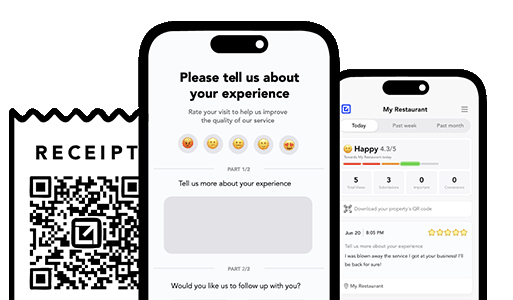
Text or email clients after every job. Catch issues early, recover unhappy clients fast, and drive repeat work with smart reminders.

Austin Spaeth is the founder of VisibleFeedback, a tool that helps service companies automate post-job follow-ups, catch issues early, and drive repeat work with smart reminders. With a background in software development and a focus on practical customer retention systems, Austin built VisibleFeedback to make it easy to text or email customers after every job, route problems to the right person, and keep relationships strong without awkward outreach. When he’s not building new features or writing playbooks for service businesses, he’s wrangling his six kids or sneaking in a beach day.
Whether you’re dealing with callbacks, unhappy customers, or low repeat work, we’ll help you tighten the follow up loop.
No credit card required.
